📌Introduction
Pharmacokinetics is an important branch of pharmacology that explains what the body does to a drug after the drug is administered. It describes how a medicine enters the body, moves through different tissues, undergoes chemical changes, and is finally removed from the body.
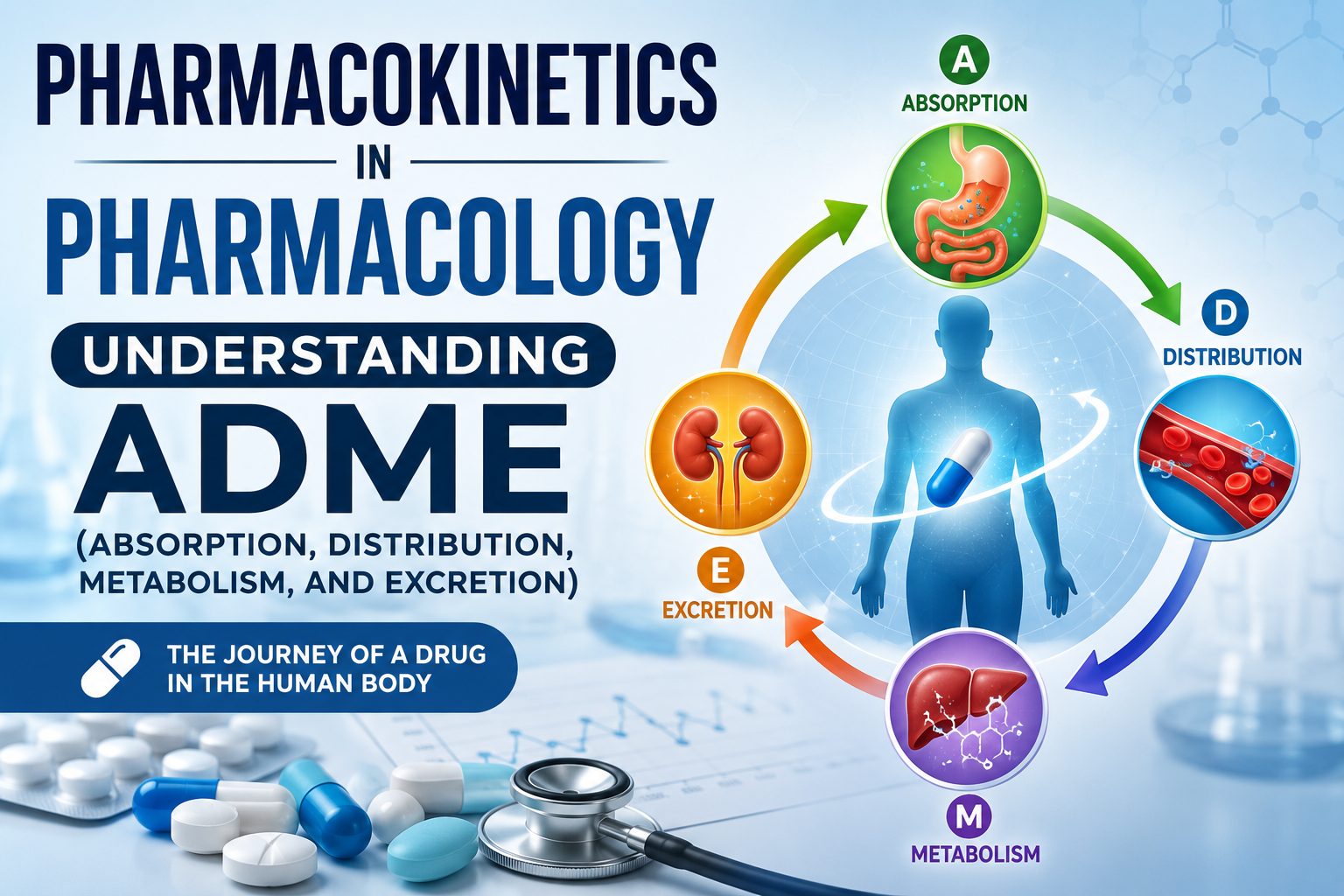
The major processes of pharmacokinetics are commonly represented by ADME:
- A – Absorption
- D – Distribution
- M – Metabolism
- E – Excretion
Understanding pharmacokinetics is important for pharmacy students because these concepts are frequently used in GPAT, RRB Pharmacist, Drug Inspector, and other pharmacy competitive examinations.
🔍What Is Pharmacokinetics?
Pharmacokinetics is the study of the movement of drugs through the body over time.
After a drug is administered, several processes occur before it produces its desired effect. The drug may first be absorbed into the bloodstream, distributed to tissues, metabolized mainly by the liver, and eventually eliminated through urine, feces, or other routes.
Pharmacokinetics vs Pharmacodynamics
These two terms are closely related but have different meanings.
| Pharmacokinetics | Pharmacodynamics |
|---|---|
| What the body does to the drug | What the drug does to the body |
| Includes ADME | Includes drug effects and mechanisms |
| Deals with drug concentration over time | Deals with response produced by the drug |
📝ADME: The Four Major Processes
1. Absorption
Absorption is the process by which a drug moves from its site of administration into the systemic circulation.
For example, after an oral tablet is swallowed, the drug must dissolve and pass through the gastrointestinal tract before reaching the bloodstream.
Factors Affecting Drug Absorption
Several factors can influence how quickly and how much of a drug is absorbed:
- Route of administration
- Drug formulation
- Lipid solubility
- Degree of ionization
- Gastrointestinal pH
- Gastric emptying
- Blood flow at the absorption site
- Food and other medicines
- Surface area available for absorption
Routes of Drug Administration
Common routes include:
- Oral
- Sublingual
- Intramuscular
- Subcutaneous
- Intravenous
- Rectal
- Transdermal
- Inhalational
Important exam point: Intravenous administration delivers the drug directly into systemic circulation and therefore generally has 100% bioavailability.
2. Distribution
Distribution is the reversible movement of a drug from the bloodstream into body tissues and fluids.
Once a drug enters systemic circulation, it may remain in the blood or move into tissues depending on its physical and chemical properties.
Factors Affecting Distribution
Important factors include:
- Blood flow to tissues
- Lipid solubility
- Capillary permeability
- Plasma protein binding
- Tissue binding
- Molecular size
- Body composition
Plasma Protein Binding
Some drugs bind to plasma proteins such as albumin.
Only the unbound fraction of a drug is generally available to move into tissues and interact with its target.
Changes in protein binding can therefore influence the amount of free drug available in the body.
3. Metabolism
Drug metabolism is the enzymatic conversion of a drug into different chemical substances called metabolites.
The liver is the major organ involved in drug metabolism, although metabolism can also occur in organs and tissues such as the intestine, kidneys, lungs, and blood.
Drug metabolism may:
- Inactivate a drug
- Activate a prodrug
- Produce active metabolites
- Produce inactive metabolites
- Produce metabolites that require further elimination
Phase I and Phase II Reactions
Drug metabolism is commonly divided into Phase I and Phase II reactions.
Phase I Reactions
Phase I reactions generally involve:
- Oxidation
- Reduction
- Hydrolysis
The cytochrome P450 enzyme system plays an important role in many oxidative drug-metabolism reactions.
Phase II Reactions
Phase II reactions involve conjugation of the drug or its metabolite with another substance.
Examples include:
- Glucuronidation
- Sulfation
- Acetylation
- Methylation
- Glutathione conjugation
These reactions often produce compounds that are more water-soluble and easier to eliminate.
First-Pass Metabolism
First-pass metabolism refers to the metabolism of a drug before a significant amount of the drug reaches systemic circulation.
This is particularly important for many drugs administered orally.
An orally administered drug may be absorbed from the gastrointestinal tract and enter the portal circulation before reaching the liver, where some of the drug can be metabolized.
Important Point
Extensive first-pass metabolism can reduce the systemic bioavailability of an orally administered drug.
This is one reason why the same drug may require different doses depending on the route of administration.
4. Excretion
Excretion is the process by which drugs and their metabolites are removed from the body.
Major Routes of Drug Excretion
The important routes include:
- Kidneys – urine
- Bile and feces
- Lungs – exhaled air
- Sweat
- Saliva
- Breast milk
The kidneys are the major organs involved in the elimination of many drugs and their metabolites.
Renal Excretion of Drugs
The kidneys eliminate drugs through three major processes:
1. Glomerular Filtration
Unbound drugs can pass from the blood into the renal filtrate through the glomerulus.
2. Tubular Secretion
Some drugs are actively transported from the blood into the renal tubules.
3. Tubular Reabsorption
Some drugs may move back from the renal tubule into the bloodstream.
The extent of reabsorption can be influenced by factors such as the drug’s lipid solubility and urinary pH.
Bioavailability
Bioavailability refers to the fraction of an administered dose that reaches systemic circulation in an unchanged form.
For an intravenous dose, bioavailability is generally considered 100%.
Oral drugs may have lower bioavailability because of incomplete absorption and first-pass metabolism.
Factors Affecting Bioavailability
- Drug absorption
- Drug formulation
- Gastrointestinal conditions
- Food
- Drug interactions
- First-pass metabolism
- Chemical stability of the drug
Volume of Distribution
Volume of distribution (Vd) is a pharmacokinetic parameter that relates the amount of drug in the body to its concentration in plasma.
A simplified relationship is:
Vd = Amount of drug in the body / Plasma drug concentration
A relatively large Vd suggests that a drug is extensively distributed outside the bloodstream, whereas a smaller Vd indicates that more of the drug remains within the vascular compartment.
Drug Clearance
Clearance describes the volume of plasma from which a drug is completely removed per unit time.
Clearance is commonly associated with organs such as:
- Kidneys
- Liver
- Lungs
Total body clearance can be considered as the combined contribution of different eliminating organs.
Clearance is an important concept when determining and adjusting drug dosage.
Half-Life of a Drug
The half-life (t½) of a drug is the time required for the concentration or amount of drug in the body to decrease by approximately 50%, under the relevant elimination conditions.
Half-life helps in understanding:
- Duration of drug action
- Dosing intervals
- Time required to reach steady state
- Time required for substantial drug elimination
A drug with a longer half-life generally remains in the body for a longer period than a drug with a shorter half-life, although actual drug effects depend on several other factors.
First-Order and Zero-Order Kinetics
Drug elimination can follow different kinetic patterns.
First-Order Kinetics
In first-order kinetics, the rate of elimination is proportional to the amount or concentration of drug present.
A constant fraction of the drug is eliminated per unit time.
This type of elimination is common for many drugs at therapeutic concentrations.
Zero-Order Kinetics
In zero-order kinetics, a constant amount of drug is eliminated per unit time.
The elimination pathway is operating at or near its capacity.
Quick Comparison
| First-Order Kinetics | Zero-Order Kinetics |
|---|---|
| Constant fraction eliminated | Constant amount eliminated |
| Rate depends on drug concentration | Rate becomes relatively independent of concentration |
| Common for many drugs | Seen with capacity-limited elimination |
| Half-life can be relatively constant under suitable conditions | Half-life is concentration-dependent |
Common Examples of Zero-Order Elimination
Important examples commonly discussed in pharmacology include:
- Ethanol
- Phenytoin at concentrations where elimination becomes capacity-limited
- Aspirin at high concentrations
Steady State
Steady state occurs when the average rate of drug administration is approximately equal to the average rate of drug elimination.
For drugs following first-order elimination, it commonly takes about 4–5 half-lives to approach steady-state concentrations during continuous or repeated dosing, although the exact time depends on the pharmacokinetic behavior of the drug.
Loading Dose and Maintenance Dose
Loading Dose
A loading dose is an initial dose given to achieve a desired therapeutic concentration more rapidly.
The loading dose is influenced by factors such as:
- Target concentration
- Volume of distribution
- Bioavailability
Maintenance Dose
A maintenance dose is used to maintain drug concentrations within the desired therapeutic range over time.
Maintenance dosing is strongly related to the drug’s clearance and the desired exposure.
📍Why Is Pharmacokinetics Important?
Pharmacokinetics helps healthcare professionals understand how a drug behaves in the body and supports appropriate dosage selection.
It is useful for:
- Selecting dosage regimens
- Determining dosing intervals
- Understanding drug accumulation
- Adjusting therapy when organ function changes
- Understanding drug interactions
- Predicting drug concentrations
- Designing safe and effective treatment plans
📑Important Pharmacokinetics Points for Pharmacy Exams
Remember these high-yield points:
- Pharmacokinetics describes what the body does to a drug.
- ADME stands for Absorption, Distribution, Metabolism, and Excretion.
- The liver is a major organ of drug metabolism.
- The kidneys are a major route of drug excretion.
- Intravenous administration generally has 100% bioavailability.
- First-pass metabolism can reduce oral drug bioavailability.
- Albumin is an important plasma protein involved in binding many drugs.
- Phase I reactions include oxidation, reduction, and hydrolysis.
- Phase II reactions commonly involve conjugation.
- Half-life represents the time required for the drug amount or concentration to decrease by approximately 50%.
- Clearance describes the removal of drug from plasma per unit time.
- Volume of distribution relates the amount of drug in the body to its plasma concentration.
- First-order kinetics involves elimination of a constant fraction per unit time.
- Zero-order kinetics involves elimination of a constant amount per unit time.
- Pharmacokinetic principles help in designing appropriate dosing regimens.
📋Frequently Asked Questions
1. What is pharmacokinetics?
Pharmacokinetics is the study of how a drug moves through the body, including absorption, distribution, metabolism, and excretion.
2. What does ADME stand for?
ADME stands for Absorption, Distribution, Metabolism, and Excretion.
3. Which organ is mainly responsible for drug metabolism?
The liver is the major organ involved in the metabolism of many drugs.
4. Which organ is important for drug excretion?
The kidneys are a major route of drug excretion.
5. What is bioavailability?
Bioavailability is the fraction of an administered drug dose that reaches systemic circulation in an unchanged form.
6. What is drug half-life?
Half-life is the time required for the amount or concentration of a drug in the body to decrease by approximately 50%.
7. What is first-pass metabolism?
It is the metabolism of a drug before a significant portion of the drug reaches systemic circulation, particularly after oral administration.
🎯Conclusion
Pharmacokinetics is one of the fundamental topics in pharmacology and pharmacy. The **ADME process—absorption, distribution, metabolism, and excretion—**provides a simple framework for understanding the journey of a drug through the body.
For competitive examinations, students should pay special attention to bioavailability, first-pass metabolism, plasma protein binding, volume of distribution, clearance, half-life, steady state, and first-order and zero-order kinetics.
A strong understanding of these concepts can make many advanced pharmacology and clinical pharmacy topics easier to understand.