📌Introduction
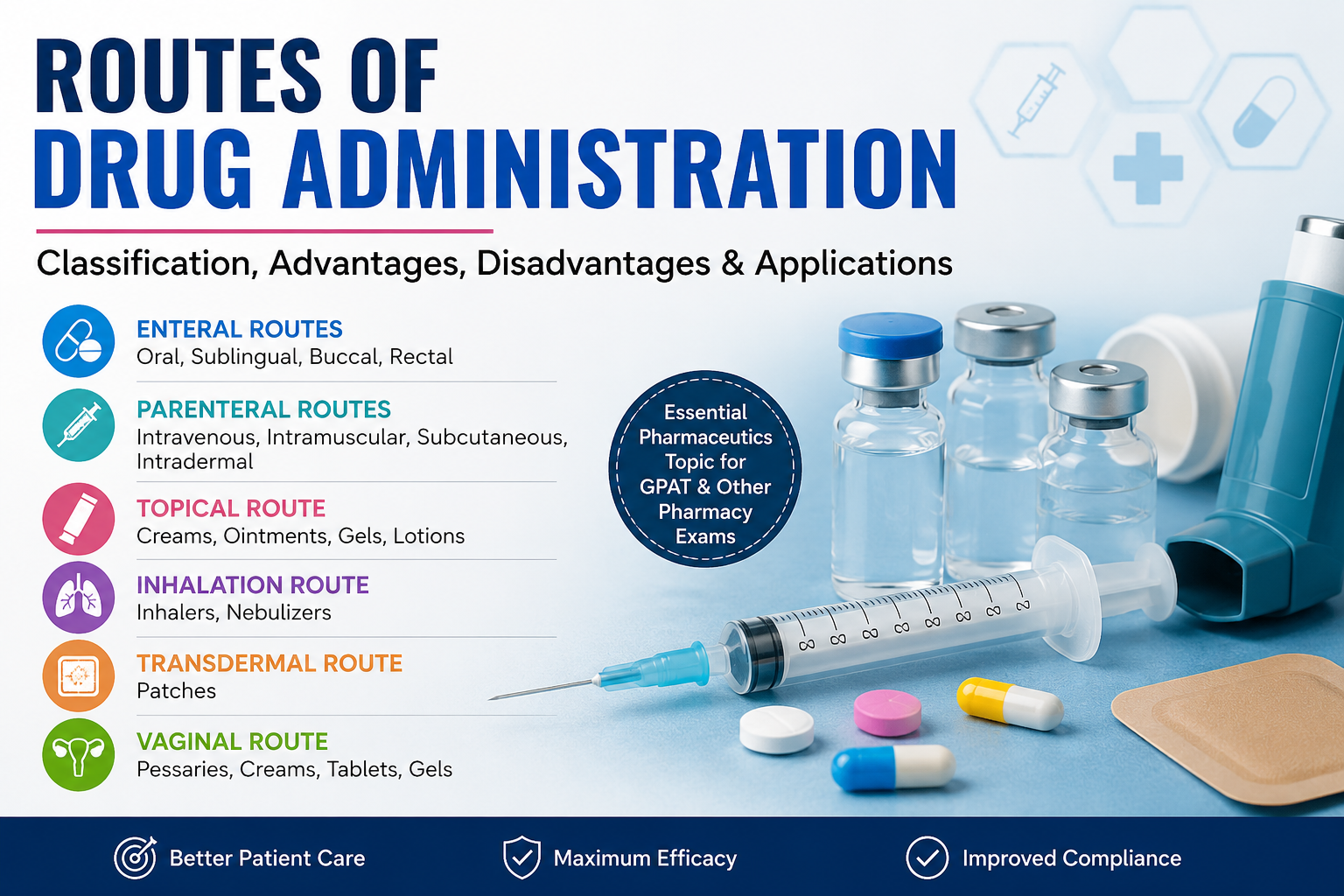
Routes of drug administration refer to the pathways through which a drug is introduced into the body to produce its therapeutic effect. The choice of the appropriate route depends on factors such as the patient’s condition, the nature of the drug, the desired onset of action, and the duration of therapy. Selecting the correct route ensures maximum efficacy, minimizes adverse effects, and improves patient compliance. A thorough understanding of drug administration routes is essential for pharmacy students and healthcare professionals. This topic is frequently asked in GPAT, NIPER, AIIMS, ESIC, DSSSB Pharmacist, RRB Pharmacist, NHM, and other government pharmacist examinations.
🔍What are Routes of Drug Administration?
A route of drug administration is the method by which a medicine enters the body to achieve its intended therapeutic effect. Drugs may be administered through the mouth, skin, lungs, muscles, veins, rectum, or other specialized routes depending on the clinical situation.
📝Classification of Routes of Drug Administration
Drug administration routes are broadly classified into two major categories:
1. Enteral Route
The enteral route involves drug administration through the gastrointestinal tract.
a) Oral Route
The oral route is the most commonly used method of drug administration. Medicines are taken by mouth in the form of tablets, capsules, syrups, powders, or suspensions.
Advantages:
- Convenient and painless
- Safe and economical
- Suitable for long-term therapy
- High patient compliance
Disadvantages:
- Slow onset of action
- First-pass metabolism in the liver
- Not suitable for unconscious or vomiting patients
- Some drugs are destroyed by gastric acid
b) Sublingual Route
In this route, the drug is placed under the tongue for rapid absorption into the bloodstream.
Examples:
- Nitroglycerin
- Isosorbide dinitrate
Advantages:
- Rapid onset of action
- Bypasses first-pass metabolism
- Suitable for emergency conditions
c) Buccal Route
The drug is placed between the cheek and gums, where it is absorbed through the oral mucosa.
Advantages:
- Avoids gastric degradation
- Provides faster absorption than oral administration
2. Parenteral Route
Parenteral administration involves delivering drugs by injection, bypassing the gastrointestinal tract.
a) Intravenous (IV)
The drug is injected directly into a vein.
Advantages:
- Immediate therapeutic effect
- 100% bioavailability
- Ideal for emergencies
- Accurate dosage control
Disadvantages:
- Requires trained personnel
- Risk of infection
- Cannot be reversed once administered
b) Intramuscular (IM)
The drug is injected into skeletal muscles.
Advantages:
- Faster absorption than oral administration
- Suitable for moderate volumes
- Useful for depot preparations
c) Subcutaneous (SC)
The drug is injected beneath the skin.
Examples:
- Insulin
- Heparin
Advantages:
- Slow and sustained drug absorption
- Easy self-administration for some medicines
d) Intradermal (ID)
The drug is injected into the dermis of the skin.
Applications:
- Tuberculin test
- Allergy testing
- Certain vaccines
Topical Route
Topical administration involves applying drugs directly to the skin or mucous membranes.
Examples:
- Creams
- Ointments
- Gels
- Lotions
Advantages:
- Localized action
- Reduced systemic side effects
- Easy application
Inhalation Route
Drugs are delivered directly into the lungs through inhalers or nebulizers.
Examples:
- Salbutamol inhaler
- Budesonide inhaler
Advantages:
- Rapid onset of action
- Direct effect on the respiratory tract
- Lower systemic toxicity
Rectal Route
Medicines are administered through the rectum using suppositories or enemas.
Advantages:
- Useful in vomiting or unconscious patients
- Partial avoidance of first-pass metabolism
Disadvantages:
- Patient discomfort
- Variable drug absorption
Vaginal Route
Drugs are administered into the vagina using pessaries, creams, tablets, or gels.
Applications:
- Antifungal therapy
- Hormonal treatment
- Local infections
Transdermal Route
Drugs are delivered through the skin using medicated patches.
Examples:
- Nicotine patches
- Nitroglycerin patches
- Fentanyl patches
Advantages:
- Sustained drug release
- Improved patient compliance
- Bypasses first-pass metabolism
🧬Factors Affecting the Choice of Route
The selection of the route of administration depends on several factors:
- Patient’s age
- Severity of disease
- Desired onset of action
- Drug stability
- Patient compliance
- Cost of treatment
- Duration of therapy
- Site of drug action
💊Importance in Pharmacy Practice
Pharmacists play an important role in selecting appropriate dosage forms and educating patients about the correct method of administration. Proper counseling improves treatment outcomes, reduces medication errors, and increases patient adherence.
📑Important Exam Points
- Oral route is the most commonly used route.
- Intravenous administration provides the fastest onset of action.
- Sublingual drugs bypass first-pass metabolism.
- Insulin is commonly administered by the subcutaneous route.
- Tuberculin testing uses the intradermal route.
- Inhalation provides direct drug delivery to the lungs.
- Transdermal patches provide sustained drug release.
- Topical preparations mainly produce local effects.
🎯Conclusion
Routes of drug administration are fundamental to effective drug therapy. Each route has unique advantages, disadvantages, and clinical applications. The choice of the appropriate route depends on the patient’s condition, drug properties, and therapeutic objectives. A clear understanding of enteral, parenteral, topical, inhalational, rectal, vaginal, and transdermal routes enables pharmacists and healthcare professionals to optimize treatment outcomes. This topic forms a vital part of pharmacy education and is frequently included in competitive examinations such as GPAT, NIPER, AIIMS, ESIC, DSSSB Pharmacist, RRB Pharmacist, and NHM. Mastering the routes of drug administration not only helps in examinations but also strengthens clinical pharmacy practice and improves patient care.
1 thought on “Routes of Drug Administration: Classification, Advantages, Disadvantages & Applications”