
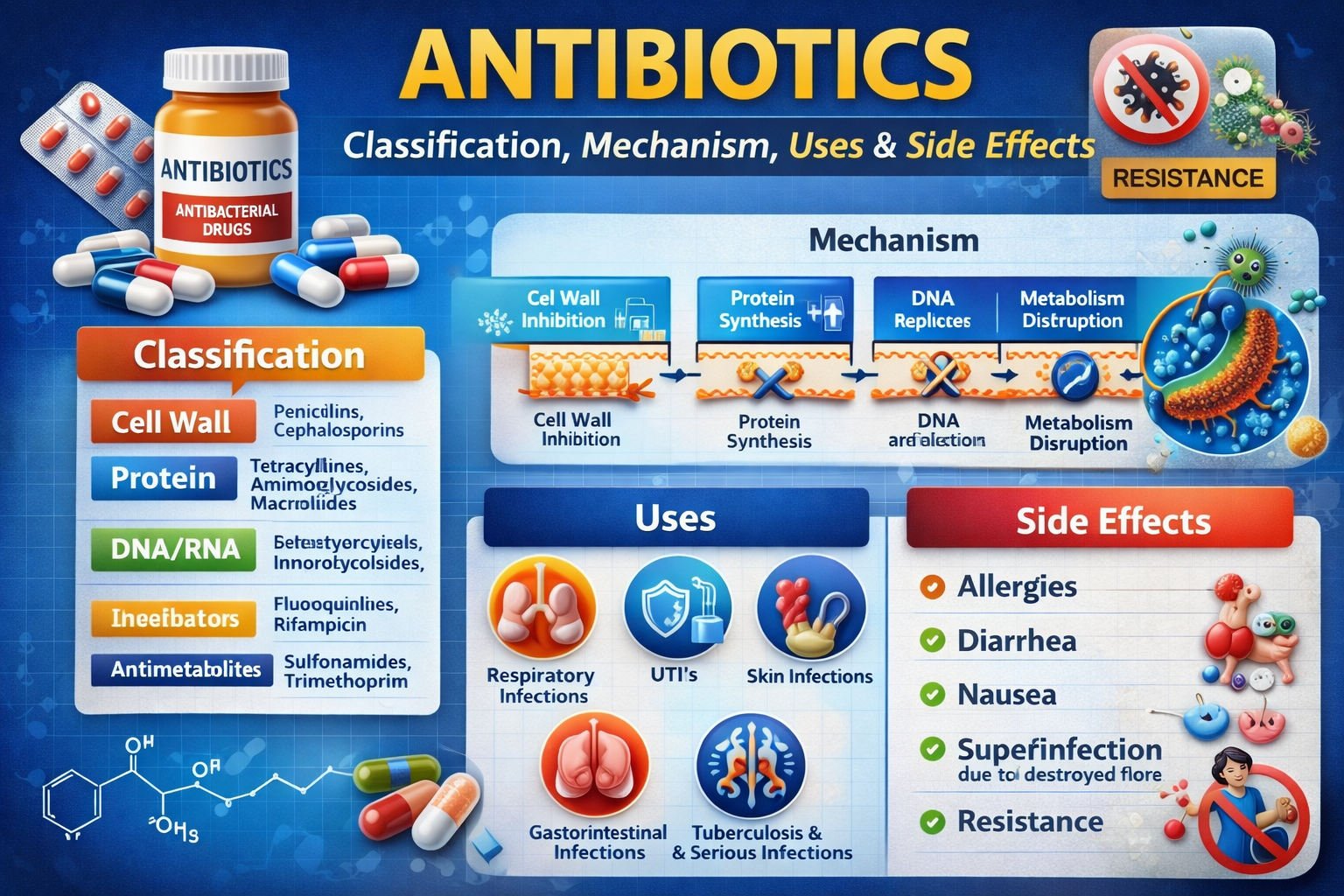
Antibiotics are medicines used to treat infections caused by susceptible bacteria. They work by targeting important bacterial structures or processes such as cell-wall synthesis, protein synthesis, DNA replication, RNA synthesis, and folate metabolism.
For pharmacy students, understanding the classification, mechanism of action, important examples, therapeutic uses, and adverse effects of antibiotics is essential for B.Pharm, D.Pharm, GPAT, pharmacist recruitment examinations, and other competitive pharmacy exams.
🔍What Are Antibiotics?
Antibiotics are substances that inhibit the growth of bacteria or kill susceptible bacteria. Depending on their mechanism and clinical use, antibiotics may act against specific groups of bacteria or have activity against a broader range of organisms.
Antibiotics are not effective against viral infections such as the common cold or most cases of influenza.
📝Classification of Antibiotics
Antibiotics can be classified according to their mechanism of action.
1. Inhibitors of Bacterial Cell-Wall Synthesis
These drugs interfere with the formation of the bacterial cell wall.
Examples:
- Penicillins – Amoxicillin, Ampicillin, Penicillin G
- Cephalosporins – Cefalexin, Cefuroxime, Ceftriaxone
- Carbapenems – Imipenem, Meropenem
- Monobactams – Aztreonam
- Glycopeptides – Vancomycin
2. Inhibitors of Protein Synthesis
These antibiotics act on bacterial ribosomes.
30S ribosomal subunit:
- Aminoglycosides – Gentamicin, Amikacin, Streptomycin
- Tetracyclines – Doxycycline, Tetracycline
50S ribosomal subunit:
- Macrolides – Azithromycin, Erythromycin, Clarithromycin
- Lincosamides – Clindamycin
- Chloramphenicol
- Oxazolidinones – Linezolid
3. Inhibitors of DNA Synthesis
Examples:
- Fluoroquinolones – Ciprofloxacin, Levofloxacin, Moxifloxacin
- Nitroimidazoles – Metronidazole
4. Inhibitors of RNA Synthesis
Example:
- Rifampicin
5. Antimetabolites
These interfere with bacterial folate metabolism.
Examples:
- Sulfonamides – Sulfamethoxazole
- Trimethoprim
6. Cell-Membrane Disrupting Antibiotics
Examples:
- Polymyxins – Colistin
- Daptomycin
🧬Mechanism of Action of Major Antibiotic Classes
1. Penicillins
Penicillins interfere with bacterial cell-wall synthesis by binding to penicillin-binding proteins (PBPs). This inhibits peptidoglycan cross-linking and weakens the bacterial cell wall.
Examples: Penicillin G, Amoxicillin, Ampicillin.
Important point: Penicillins are generally bactericidal against susceptible bacteria.
Common adverse effects:
- Hypersensitivity reactions
- Rash
- Gastrointestinal disturbances
- Diarrhea
2. Cephalosporins
Cephalosporins also inhibit bacterial cell-wall synthesis through interaction with PBPs.
Examples: Cefalexin, Cefuroxime, Ceftriaxone, Cefepime.
They are commonly divided into generations, with differences in antibacterial spectrum and resistance to bacterial β-lactamases.
Important adverse effects:
- Allergic reactions
- Gastrointestinal disturbances
- Diarrhea
3. Carbapenems
Carbapenems are broad-spectrum β-lactam antibiotics that inhibit bacterial cell-wall synthesis.
Examples: Imipenem, Meropenem, Ertapenem.
They are often reserved for serious infections involving susceptible or resistant organisms.
Adverse effects may include:
- Gastrointestinal effects
- Hypersensitivity
- Seizures can occur with certain agents, particularly in susceptible patients
4. Glycopeptides
Vancomycin inhibits bacterial cell-wall synthesis by binding to a component of the peptidoglycan precursor, preventing proper cell-wall formation.
It is particularly important against susceptible Gram-positive bacteria.
Important adverse effects:
- Infusion-related reactions
- Nephrotoxicity
- Ototoxicity is a less common concern
Protein-Synthesis Inhibitors
5. Aminoglycosides
Aminoglycosides bind to the 30S ribosomal subunit and interfere with bacterial protein synthesis.
Examples:
- Gentamicin
- Amikacin
- Streptomycin
- Tobramycin
Important adverse effects:
- Nephrotoxicity
- Ototoxicity
- Neuromuscular blockade in susceptible situations
Exam point: Aminoglycosides are generally considered bactericidal.
6. Tetracyclines
Tetracyclines bind to the 30S ribosomal subunit and prevent aminoacyl-tRNA from attaching to the bacterial ribosome.
Examples:
- Tetracycline
- Doxycycline
- Minocycline
Important adverse effects:
- Gastrointestinal irritation
- Photosensitivity
- Tooth discoloration and effects on developing bone
Exam point: Tetracyclines are generally bacteriostatic.
7. Macrolides
Macrolides bind to the 50S ribosomal subunit and inhibit bacterial protein synthesis.
Examples:
- Azithromycin
- Erythromycin
- Clarithromycin
They are commonly used for susceptible respiratory and other bacterial infections.
Adverse effects:
- Gastrointestinal disturbances
- QT interval prolongation with some agents
- Drug interactions with certain macrolides
8. Chloramphenicol
Chloramphenicol binds to the 50S ribosomal subunit and inhibits bacterial protein synthesis.
It has broad antibacterial activity but its use is limited because of potentially serious adverse effects.
Important adverse effects:
- Bone-marrow suppression
- Rare but serious aplastic anemia
- Gray baby syndrome in neonates
High-yield point: Chloramphenicol is strongly associated with aplastic anemia.
9. Clindamycin
Clindamycin is a lincosamide that acts on the 50S ribosomal subunit.
It is useful against various susceptible Gram-positive organisms and anaerobes.
Important adverse effect:
Clindamycin is associated with Clostridioides difficile-associated diarrhea and colitis.
10. Linezolid
Linezolid belongs to the oxazolidinone group and inhibits bacterial protein synthesis by interfering with formation of the initiation complex.
It is important for selected serious Gram-positive infections.
Important adverse effects:
- Myelosuppression, especially with prolonged therapy
- Peripheral or optic neuropathy with prolonged use
- Important interactions with serotonergic medicines
Antibiotics Affecting DNA or RNA
11. Fluoroquinolones
Fluoroquinolones interfere with bacterial DNA replication by inhibiting bacterial enzymes such as DNA gyrase and topoisomerase IV.
Examples:
- Ciprofloxacin
- Levofloxacin
- Moxifloxacin
Adverse effects and precautions may include:
- Gastrointestinal effects
- Central nervous system effects
- Tendon-related injury
- QT prolongation with some agents
Exam point: Ciprofloxacin is particularly associated with inhibition of bacterial DNA gyrase.
12. Metronidazole
Metronidazole is activated in susceptible anaerobic organisms and produces reactive intermediates that damage bacterial DNA.
It is important in the treatment of susceptible anaerobic infections and certain protozoal infections.
Adverse effects:
- Nausea
- Metallic taste
- Gastrointestinal discomfort
- Peripheral neuropathy with prolonged use
13. Rifampicin
Rifampicin inhibits bacterial DNA-dependent RNA polymerase, thereby suppressing RNA synthesis.
It is an important drug in the treatment of tuberculosis, used as part of combination therapy.
Important adverse effects:
- Hepatotoxicity
- Gastrointestinal effects
- Orange-red discoloration of body fluids
High-yield point: Rifampicin → RNA polymerase inhibition.
Antimetabolite Antibiotics
14. Sulfonamides
Sulfonamides inhibit bacterial folate synthesis by interfering with the enzyme dihydropteroate synthase.
Example: Sulfamethoxazole.
15. Trimethoprim
Trimethoprim inhibits dihydrofolate reductase, another enzyme involved in bacterial folate metabolism.
Trimethoprim is commonly combined with sulfamethoxazole to produce sequential inhibition of folate synthesis.
Combination:
Trimethoprim + Sulfamethoxazole = Co-trimoxazole
Cell-Membrane Disrupting Antibiotics
Polymyxins
Polymyxins interact with bacterial cell membranes and disturb membrane integrity.
Example: Colistin.
They are mainly important for selected serious infections caused by susceptible Gram-negative organisms.
Important concern: Nephrotoxicity and neurotoxicity can occur.
Bactericidal vs Bacteriostatic Antibiotics
Bactericidal antibiotics
These kill susceptible bacteria.
Examples include:
- Penicillins
- Cephalosporins
- Aminoglycosides
- Fluoroquinolones
- Vancomycin
Bacteriostatic antibiotics
These primarily inhibit bacterial growth, allowing host defenses to help eliminate the infection.
Examples include:
- Tetracyclines
- Macrolides
- Chloramphenicol
- Clindamycin
The bactericidal/bacteriostatic distinction is useful for examination purposes, but actual clinical effects can vary depending on the organism, drug concentration, infection site, and patient factors.
Important Adverse Effects:
- Penicillins → hypersensitivity reactions
- Aminoglycosides → nephrotoxicity + ototoxicity
- Tetracyclines → teeth/bone effects + photosensitivity
- Macrolides → GI effects + QT prolongation with some agents
- Chloramphenicol → aplastic anemia
- Clindamycin → C. difficile-associated diarrhea/colitis
- Fluoroquinolones → tendon-related injury and other important adverse effects
- Vancomycin → infusion-related reactions + nephrotoxicity
- Rifampicin → hepatotoxicity + orange-red body fluids
- Metronidazole → metallic taste + GI effects
- Colistin → nephrotoxicity + neurotoxicity
Antibiotic Resistance
Antibiotic resistance occurs when bacteria develop the ability to survive exposure to antibiotics that would normally inhibit or kill them.
Major mechanisms of resistance
Enzymatic drug inactivation
Example: β-lactamases can break down certain β-lactam antibiotics.Alteration of drug target
Bacteria may modify the structure to which an antibiotic normally binds.Reduced drug entry
Changes in bacterial permeability can reduce antibiotic uptake.Efflux pumps
Bacteria can actively remove antibiotics from the cell.Alternative metabolic pathways
Bacteria may develop alternative pathways that bypass the drug’s target.
How to Reduce Antibiotic Resistance
- Use antibiotics only when appropriate.
- Follow the prescribed treatment regimen.
- Avoid unnecessary antibiotic use.
- Do not use leftover antibiotics without appropriate medical advice.
- Follow infection-control and hygiene practices.
- Use culture and susceptibility information when clinically appropriate.
📋Quick Revision Table
| Antibiotic | Class | Main Target/Action |
|---|---|---|
| Amoxicillin | Penicillin | Cell-wall synthesis |
| Ceftriaxone | Cephalosporin | Cell-wall synthesis |
| Meropenem | Carbapenem | Cell-wall synthesis |
| Vancomycin | Glycopeptide | Cell-wall synthesis |
| Gentamicin | Aminoglycoside | 30S ribosome |
| Doxycycline | Tetracycline | 30S ribosome |
| Azithromycin | Macrolide | 50S ribosome |
| Clindamycin | Lincosamide | 50S ribosome |
| Linezolid | Oxazolidinone | Protein-synthesis initiation |
| Ciprofloxacin | Fluoroquinolone | DNA gyrase/topoisomerase |
| Metronidazole | Nitroimidazole | DNA damage |
| Rifampicin | Rifamycin | RNA polymerase |
| Sulfamethoxazole | Sulfonamide | Dihydropteroate synthase |
| Trimethoprim | Antifolate | Dihydrofolate reductase |
| Colistin | Polymyxin | Bacterial cell membrane |
📑Important Exam Tips
- Penicillins → inhibit bacterial cell-wall synthesis.
- Vancomycin → glycopeptide acting on cell-wall synthesis.
- Aminoglycosides → act on the 30S ribosomal subunit.
- Tetracyclines → inhibit attachment of aminoacyl-tRNA to the 30S subunit.
- Macrolides → act on the 50S ribosomal subunit.
- Chloramphenicol → inhibits peptidyl transferase activity.
- Fluoroquinolones → inhibit DNA gyrase/topoisomerase enzymes.
- Rifampicin → inhibits bacterial DNA-dependent RNA polymerase.
- Sulfonamides → inhibit dihydropteroate synthase.
- Trimethoprim → inhibits dihydrofolate reductase.
- Clindamycin → important adverse effect is C. difficile-associated diarrhea/colitis.
- Aminoglycosides → nephrotoxicity and ototoxicity are major concerns.
- Tetracyclines → can cause tooth discoloration in developing teeth.
- Rifampicin → can cause orange-red discoloration of body fluids.
🎯 Conclusion
Antibiotics are an important part of pharmacology, and understanding their classification, mechanism of action, uses, adverse effects, and resistance mechanisms makes revision much easier.
For pharmacy examinations, focus particularly on the ribosomal target, bacterial enzyme inhibited, major adverse effect, and important clinical use of each antibiotic class. These points are frequently useful for MCQs and short-answer questions.
Educational note: This article is intended for pharmacy education and examination preparation. Antibiotics should be used under appropriate medical guidance, and treatment decisions should be based on the individual clinical situation.
4 thoughts on “Antibiotics: Classification, Mechanism of Action, Uses, Adverse Effects & Resistance”