📌 Introduction
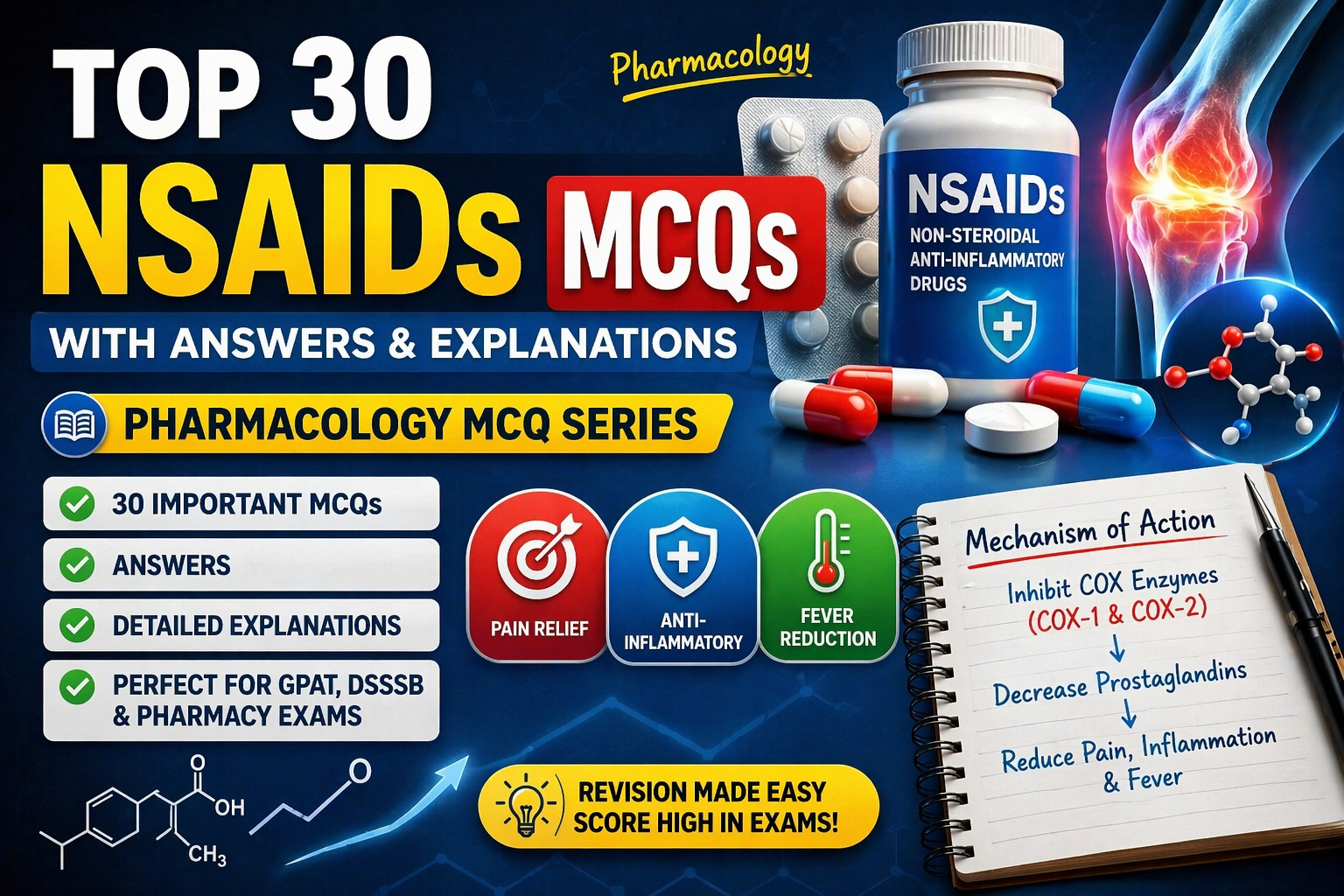
NSAIDs (Non-Steroidal Anti-Inflammatory Drugs) are one of the most important topics in pharmacology. They are widely used for pain, inflammation, and fever and are frequently asked in exams like GPAT, DSSSB, and other pharmacy competitive exams. Practicing MCQs helps in quick revision and better understanding of concepts.
📝 MCQs on NSAIDs
1. NSAIDs primarily act by inhibiting:
A) Lipoxygenase
B) Cyclooxygenase
C) Protease
D) Amylase
✔ Answer: B) Cyclooxygenase
➜ Explanation: NSAIDs inhibit COX enzymes responsible for prostaglandin synthesis.
2. COX stands for:
A) Cyclooxygenase
B) Carboxylase
C) Oxidase
D) Catalase
✔ Answer: A) Cyclooxygenase
➜ Explanation: It is the enzyme involved in prostaglandin formation.
3. Aspirin irreversibly inhibits:
A) COX-1
B) COX-2
C) Both COX-1 and COX-2
D) Lipoxygenase
✔ Answer: C) Both COX-1 and COX-2
➜ Explanation: Aspirin permanently inhibits both enzymes.
4. Which NSAID is selective COX-2 inhibitor?
A) Ibuprofen
B) Diclofenac
C) Celecoxib
D) Aspirin
✔ Answer: C) Celecoxib
➜ Explanation: It selectively inhibits COX-2.
5. NSAIDs reduce pain by decreasing:
A) Dopamine
B) Prostaglandins
C) Serotonin
D) Insulin
✔ Answer: B) Prostaglandins
➜ Explanation: Prostaglandins cause pain and inflammation.
6. Which is a common NSAID?
A) Paracetamol
B) Ibuprofen
C) Insulin
D) Penicillin
✔ Answer: B) Ibuprofen
➜ Explanation: Widely used NSAID.
7. NSAIDs are used in:
A) Infection
B) Pain
C) Cancer
D) Diabetes
✔ Answer: B) Pain
➜ Explanation: They act as analgesics.
8. Which enzyme protects gastric mucosa?
A) COX-1
B) COX-2
C) Lipase
D) Protease
✔ Answer: A) COX-1
➜ Explanation: COX-1 maintains stomach lining.
9. Major side effect of NSAIDs:
A) Hypertension
B) Gastric ulcer
C) Hair loss
D) Blindness
✔ Answer: B) Gastric ulcer
➜ Explanation: Due to COX-1 inhibition.
10. Diclofenac is:
A) Weak NSAID
B) Strong anti-inflammatory
C) Antibiotic
D) Antiviral
✔ Answer: B) Strong anti-inflammatory
➜ Explanation: Potent NSAID.
11. NSAIDs reduce fever by acting on:
A) Liver
B) Hypothalamus
C) Kidney
D) Heart
✔ Answer: B) Hypothalamus
➜ Explanation: Controls body temperature.
12. Meloxicam is:
A) Non-selective
B) Preferential COX-2 inhibitor
C) Antibiotic
D) Hormone
✔ Answer: B) Preferential COX-2 inhibitor
➜ Explanation: More selective for COX-2.
13. Which NSAID is safest for stomach?
A) Aspirin
B) Ibuprofen
C) Celecoxib
D) Indomethacin
✔ Answer: C) Celecoxib
➜ Explanation: Selective COX-2 inhibitor.
14. NSAIDs may cause:
A) Kidney damage
B) Improved vision
C) Hair growth
D) Weight gain
✔ Answer: A) Kidney damage
➜ Explanation: Long-term use affects kidneys.
15. Aspirin has:
A) Antiplatelet action
B) Antifungal action
C) Antiviral action
D) Hormonal action
✔ Answer: A) Antiplatelet action
➜ Explanation: Prevents clot formation.
16. Which is NOT NSAID?
A) Ibuprofen
B) Diclofenac
C) Paracetamol
D) Amoxicillin
✔ Answer: D) Amoxicillin
➜ Explanation: It is an antibiotic.
17. NSAIDs are contraindicated in:
A) Fever
B) Peptic ulcer
C) Headache
D) Pain
✔ Answer: B) Peptic ulcer
➜ Explanation: Risk of bleeding.
18. COX-2 is mainly involved in:
A) Protection
B) Inflammation
C) Digestion
D) Respiration
✔ Answer: B) Inflammation
➜ Explanation: Produces inflammatory mediators.
19. Indomethacin is used in:
A) Gout
B) Diabetes
C) Cancer
D) Infection
✔ Answer: A) Gout
➜ Explanation: Reduces inflammation.
20. NSAIDs decrease:
A) Platelets
B) Prostaglandins
C) Insulin
D) Oxygen
✔ Answer: B) Prostaglandins
➜ Explanation: Main mechanism.
21. Which causes least gastric irritation?
A) Aspirin
B) Indomethacin
C) Celecoxib
D) Diclofenac
✔ Answer: C) Celecoxib
➜ Explanation: COX-2 selective.
22. NSAIDs are analgesic because:
A) Increase pain
B) Reduce prostaglandins
C) Increase serotonin
D) Increase insulin
✔ Answer: B) Reduce prostaglandins
23. Which is used in arthritis?
A) Ibuprofen
B) Insulin
C) Penicillin
D) Vitamin C
✔ Answer: A) Ibuprofen
24. NSAIDs may increase risk of:
A) Bleeding
B) Vision
C) Growth
D) Immunity
✔ Answer: A) Bleeding
25. Aspirin should be avoided in:
A) Adults
B) Children with viral infection
C) Elderly
D) Athletes
✔ Answer: B) Children with viral infection
➜ Explanation: Risk of Reye’s syndrome.
26. Which NSAID is most potent?
A) Diclofenac
B) Aspirin
C) Ibuprofen
D) Paracetamol
✔ Answer: A) Diclofenac
27. NSAIDs act on:
A) DNA
B) Enzymes
C) Hormones
D) Protein
✔ Answer: B) Enzymes
28. Prostaglandins cause:
A) Pain
B) Sleep
C) Growth
D) Digestion
✔ Answer: A) Pain
29. NSAIDs are anti-inflammatory because they:
A) Increase COX
B) Decrease COX
C) Increase hormones
D) Increase insulin
✔ Answer: B) Decrease COX
30. Best use of NSAIDs:
A) Infection
B) Pain & inflammation
C) Cancer
D) Diabetes
✔ Answer: B) Pain & inflammation
🎯 Conclusion
These 30 MCQs on NSAIDs will help you revise important pharmacology concepts quickly. Regular practice improves accuracy and helps in scoring better in exams like GPAT and DSSSB.
👉 Read full notes here: https://pharmacymcq.in/nsaids-classification-mechanism-uses-side-effects/
1 thought on “Top 30 MCQs on NSAIDs with Answers & Explanation”