📌Introduction
The human cardiovascular system is one of the most important systems of the body. It is responsible for continuously circulating blood throughout the body and supplying tissues with oxygen and nutrients.
The cardiovascular system also removes carbon dioxide and other waste products from tissues. It plays an important role in maintaining body temperature, fluid balance, blood pressure, and overall homeostasis.
For B.Pharm students, understanding the cardiovascular system is essential because many important drugs act on the heart and blood vessels. Knowledge of cardiovascular anatomy provides a foundation for studying cardiovascular pharmacology.
🔍What is the Cardiovascular System?
The cardiovascular system, also called the circulatory system, is a network consisting mainly of:
- Heart
- Blood vessels
- Blood
The heart acts as a muscular pump, while blood vessels provide pathways through which blood circulates throughout the body.
The cardiovascular system has two major circulatory pathways:
- Pulmonary circulation
- Systemic circulation
1. Heart
The heart is a muscular organ located in the thoracic cavity between the lungs. It is approximately the size of a closed fist.
The primary function of the heart is to pump blood throughout the body.
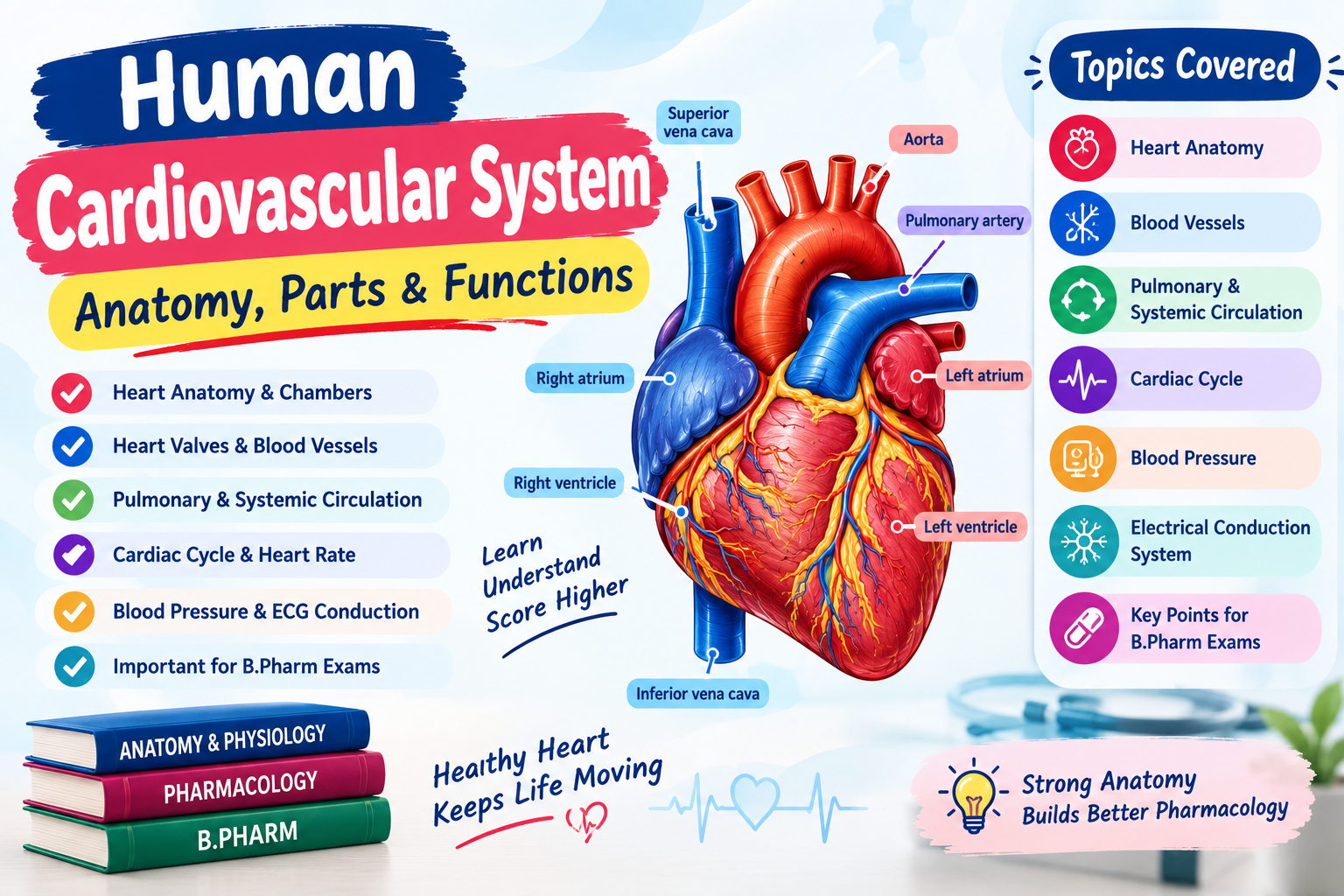
The heart is divided into four chambers:
- Right atrium
- Right ventricle
- Left atrium
- Left ventricle
Right Atrium
The right atrium receives deoxygenated blood returning from the body.
It receives blood mainly through:
- Superior vena cava
- Inferior vena cava
The right atrium passes blood into the right ventricle through the tricuspid valve.
Right Ventricle
The right ventricle receives deoxygenated blood from the right atrium.
It pumps blood toward the lungs through the pulmonary artery.
The pulmonary artery carries deoxygenated blood from the heart to the lungs for oxygenation.
Left Atrium
The left atrium receives oxygenated blood from the lungs through the pulmonary veins.
It passes oxygenated blood into the left ventricle through the mitral valve.
Left Ventricle
The left ventricle is the strongest and thickest chamber of the heart.
It pumps oxygenated blood into the aorta, which distributes blood to the rest of the body.
Because the left ventricle pumps blood through the systemic circulation, its muscular wall is thicker than that of the right ventricle.
🧬Heart Valves
Heart valves ensure that blood flows in the correct direction and prevents significant backflow.
The four major heart valves are:
1. Tricuspid Valve
The tricuspid valve is located between the right atrium and right ventricle.
2. Pulmonary Valve
The pulmonary valve is located between the right ventricle and pulmonary artery.
3. Mitral Valve
The mitral valve, also called the bicuspid valve, is located between the left atrium and left ventricle.
4. Aortic Valve
The aortic valve is located between the left ventricle and aorta.
🩸Blood Vessels
Blood vessels are tubular structures that transport blood throughout the body.
The three major types of blood vessels are:
- Arteries
- Veins
- Capillaries
Arteries
Arteries generally carry blood away from the heart.
They usually have thick, elastic and muscular walls because they carry blood under relatively high pressure.
Most arteries carry oxygenated blood.
However, the pulmonary artery carries deoxygenated blood from the right ventricle to the lungs.
Veins
Veins generally carry blood toward the heart.
They have thinner walls than arteries and often contain valves that help prevent backward flow of blood.
Most veins carry deoxygenated blood.
However, pulmonary veins carry oxygenated blood from the lungs to the left atrium.
Capillaries
Capillaries are microscopic blood vessels that connect the smallest arteries and veins.
They have very thin walls, usually consisting of a single layer of endothelial cells.
Capillaries are the major sites for exchange of:
- Oxygen
- Carbon dioxide
- Nutrients
- Water
- Waste products
between blood and tissues.
Pulmonary Circulation
Pulmonary circulation is the movement of blood between the heart and lungs.
The pathway is:
Right ventricle → Pulmonary artery → Lungs → Pulmonary veins → Left atrium
In the lungs, deoxygenated blood releases carbon dioxide and receives oxygen.
The oxygenated blood then returns to the left side of the heart through the pulmonary veins.
Systemic Circulation
Systemic circulation carries oxygenated blood from the heart to the tissues of the body and returns deoxygenated blood to the heart.
The basic pathway is:
Left ventricle → Aorta → Body tissues → Veins → Right atrium
The systemic circulation supplies tissues with oxygen and nutrients and carries carbon dioxide and other waste products away from tissues.
Coronary Circulation
The heart itself requires a continuous supply of oxygen and nutrients.
This is provided by the coronary arteries.
The coronary arteries arise from the aorta and supply blood to the cardiac muscle.
Reduced blood flow through coronary arteries can cause inadequate oxygen supply to the heart muscle.
Cardiac Cycle
The cardiac cycle refers to the sequence of events that occurs during one complete heartbeat.
It mainly includes:
- Atrial systole
- Ventricular systole
- Diastole
Atrial Systole
During atrial systole, the atria contract and push blood into the ventricles.
Ventricular Systole
During ventricular systole, the ventricles contract and pump blood into the pulmonary artery and aorta.
Diastole
During diastole, the heart chambers relax and fill with blood.
The coordinated contraction and relaxation of the heart allow continuous blood circulation.
🫀Heart Rate
Heart rate refers to the number of heartbeats per minute.
In a healthy resting adult, the normal resting heart rate is commonly around 60–100 beats per minute, although it can vary depending on factors such as age, fitness, activity, emotions, and medications.
The heart’s rhythm is regulated by specialized electrical conduction tissues.
📍Electrical Conduction System of the Heart
The heart has a specialized conduction system that generates and transmits electrical impulses.
Important structures include:
- Sinoatrial (SA) node
- Atrioventricular (AV) node
- Bundle of His
- Right and left bundle branches
- Purkinje fibers
Sinoatrial (SA) Node
The SA node is located in the right atrium and normally acts as the natural pacemaker of the heart.
It initiates electrical impulses that begin each normal heartbeat.
Atrioventricular (AV) Node
The AV node receives the electrical signal from the atria and helps regulate its transmission toward the ventricles.
Bundle of His and Purkinje Fibers
The electrical impulse travels through the bundle of His, bundle branches, and Purkinje fibers to coordinate ventricular contraction.
🌡️Blood Pressure
Blood pressure is the force exerted by circulating blood against the walls of blood vessels, particularly arteries.
It is commonly expressed using two values:
Systolic Blood Pressure
It represents arterial pressure during ventricular contraction.
Diastolic Blood Pressure
It represents arterial pressure during ventricular relaxation.
Blood pressure is influenced by several factors, including cardiac output, blood volume, blood vessel resistance, and vascular elasticity.
🩺Functions of the Cardiovascular System
The cardiovascular system performs several important functions.
1. Transport
It transports oxygen, nutrients, hormones, and other substances throughout the body.
2. Removal of Waste Products
It transports carbon dioxide and metabolic waste products to organs involved in their removal.
3. Regulation
It helps regulate body temperature, fluid balance, and acid-base balance.
4. Protection
Blood contains cells and proteins involved in immune defense and clotting.
5. Maintenance of Homeostasis
The cardiovascular system contributes to maintaining a stable internal environment of the body.
📑Importance of the Cardiovascular System in Pharmacy
The cardiovascular system is extremely important in pharmacology because many commonly used medicines act on the heart and blood vessels.
Important cardiovascular drug groups include:
- Antihypertensive drugs
- Antianginal drugs
- Antiarrhythmic drugs
- Diuretics
- Anticoagulants
- Antiplatelet drugs
- Cardiac glycosides
- Lipid-lowering drugs
Pharmacy students should understand heart anatomy, blood circulation, cardiac conduction, blood pressure, and blood vessels before studying cardiovascular pharmacology in detail.
📋Quick Revision Points
📌 Heart = Muscular pump responsible for blood circulation
📌 Heart has 4 chambers = Right atrium, right ventricle, left atrium, left ventricle
📌 Right atrium = Receives deoxygenated blood from the body
📌 Right ventricle = Pumps deoxygenated blood to the lungs
📌 Left atrium = Receives oxygenated blood from the lungs
📌 Left ventricle = Pumps oxygenated blood to the body
📌 Tricuspid valve = Between right atrium and right ventricle
📌 Mitral valve = Between left atrium and left ventricle
📌 Pulmonary artery = Carries deoxygenated blood to the lungs
📌 Pulmonary veins = Carry oxygenated blood to the left atrium
📌 Aorta = Main artery carrying blood from the left ventricle to the body
📌 Capillaries = Major site of exchange between blood and tissues
📌 SA node = Natural pacemaker of the heart
📌 Pulmonary circulation = Heart ↔ Lungs
📌 Systemic circulation = Heart ↔ Body tissues
📝Frequently Asked Questions
1. How many chambers are present in the human heart?
The human heart has four chambers: two atria and two ventricles.
2. Which chamber of the heart pumps blood to the entire body?
The left ventricle pumps oxygenated blood into the aorta and therefore supplies the systemic circulation.
3. Which artery carries deoxygenated blood?
The pulmonary artery carries deoxygenated blood from the right ventricle to the lungs.
4. Which veins carry oxygenated blood?
The pulmonary veins carry oxygenated blood from the lungs to the left atrium.
5. What is the natural pacemaker of the heart?
The sinoatrial (SA) node normally acts as the natural pacemaker of the heart.
6. What is the main function of capillaries?
Capillaries provide a major site for exchange of oxygen, carbon dioxide, nutrients, water, and waste products between blood and tissues.
🎯Conclusion
The cardiovascular system is essential for maintaining life because it continuously transports oxygen, nutrients, hormones, and other substances throughout the body while removing metabolic waste products.
The heart, blood vessels, and blood work together to maintain continuous circulation. Understanding the chambers of the heart, heart valves, pulmonary and systemic circulation, cardiac cycle, electrical conduction system, and blood pressure is essential for B.Pharm students.
A strong foundation in cardiovascular anatomy makes it easier to understand cardiovascular pharmacology and important drug classes used in the treatment of cardiovascular disorders.
Keep learning, revising, and practicing important Anatomy & Physiology concepts for your pharmacy exams.