📌Introduction
Drug dosage forms are the physical forms in which medicines are prepared and administered to patients. They are designed to deliver the correct amount of drug safely, effectively, and conveniently. A suitable dosage form improves patient compliance, enhances therapeutic efficacy, protects the drug from degradation, and ensures accurate dosing. The selection of a dosage form depends on factors such as the patient’s age, medical condition, route of administration, onset of action, and the physicochemical properties of the drug. Knowledge of dosage forms is essential for pharmacy students and is frequently tested in GPAT, NIPER, DSSSB Pharmacist, AIIMS, ESIC, RRB Pharmacist, and other government pharmacist examinations.
🔍What is a Drug Dosage Form?
A drug dosage form is the physical form in which a pharmaceutical product is produced and dispensed. It contains the active pharmaceutical ingredient (API) along with excipients that improve stability, taste, appearance, and drug delivery.
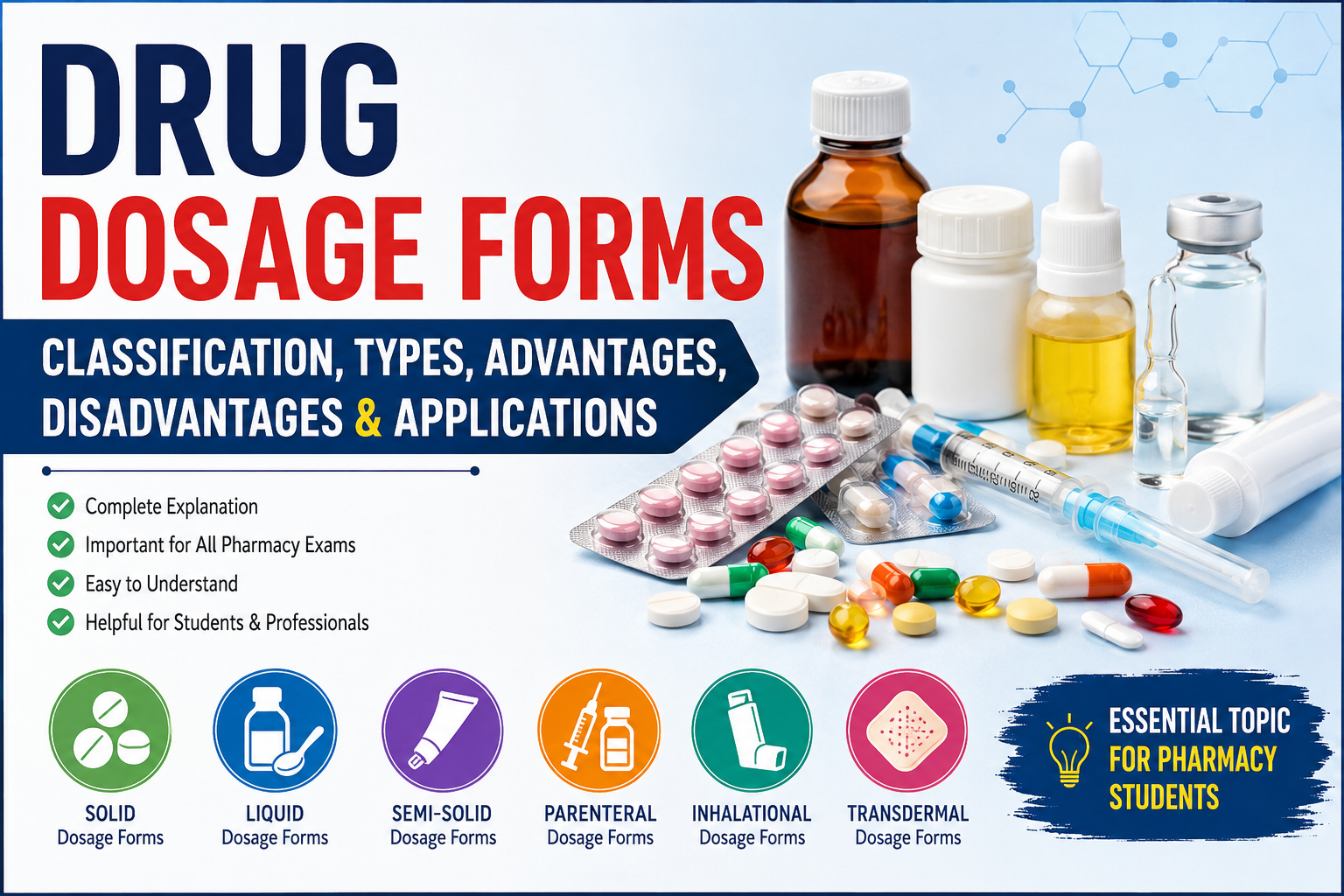
Drug dosage forms are classified according to their physical state and route of administration.
1. Solid Dosage Forms
📝Classification of Drug Dosage Forms
Solid dosage forms are the most commonly used pharmaceutical preparations.
Examples include:
- Tablets
- Capsules
- Powders
- Granules
- Lozenges
Advantages:
- Easy to transport and store
- Accurate dosing
- Longer shelf life
- Cost-effective
Disadvantages:
- Difficult for children and elderly patients to swallow
- Slower onset of action than liquids
2. Liquid Dosage Forms
Liquid preparations are suitable for patients who have difficulty swallowing tablets or capsules.
Examples include:
- Syrups
- Suspensions
- Solutions
- Elixirs
- Drops
Advantages:
- Easy to swallow
- Faster absorption
- Suitable for pediatric and geriatric patients
Disadvantages:
- Shorter shelf life
- Risk of contamination
- Measuring errors during administration
3. Semi-solid Dosage Forms
Semi-solid preparations are applied externally to the skin or mucous membranes.
Examples include:
- Ointments
- Creams
- Gels
- Pastes
Advantages:
- Localized drug action
- Reduced systemic side effects
- Easy application
Disadvantages:
- Greasy texture in some preparations
- Limited penetration through the skin
4. Parenteral Dosage Forms
Parenteral preparations are administered by injection.
Examples include:
- Intravenous injections
- Intramuscular injections
- Subcutaneous injections
Advantages:
- Rapid onset of action
- Suitable for emergency conditions
- Useful for unconscious patients
Disadvantages:
- Painful administration
- Requires trained healthcare professionals
- Higher risk of infection if not administered properly
5. Inhalational Dosage Forms
These dosage forms deliver drugs directly to the respiratory tract.
Examples include:
- Metered-dose inhalers
- Dry powder inhalers
- Nebulizers
Advantages:
- Rapid therapeutic effect
- Direct action on the lungs
- Lower systemic adverse effects
6. Transdermal Dosage Forms
Transdermal patches deliver drugs through the skin into systemic circulation.
Examples include:
- Nicotine patches
- Nitroglycerin patches
- Fentanyl patches
Advantages:
- Sustained drug release
- Improved patient compliance
- Avoids first-pass metabolism
💊Factors Affecting the Selection of Dosage Forms
Several factors influence the choice of dosage form:
- Age of the patient
- Severity of disease
- Route of administration
- Desired onset and duration of action
- Drug stability
- Patient compliance
- Cost and availability
🟢Ideal Characteristics of a Dosage Form
An ideal dosage form should:
- Deliver an accurate dose
- Be stable during storage
- Be easy to administer
- Be acceptable in taste and appearance
- Produce the desired therapeutic effect
- Be economical and convenient
🧬Importance of Drug Dosage Forms
Drug dosage forms play a significant role in successful treatment by:
- Improving patient compliance
- Ensuring accurate dosing
- Protecting drugs from environmental factors
- Enhancing bioavailability
- Providing controlled or sustained drug release
- Reducing adverse effects
🩺Role of Pharmacists
Pharmacists are responsible for selecting, dispensing, and counseling patients about the correct dosage forms. They educate patients on proper administration techniques, storage conditions, dosing schedules, and possible adverse effects. Pharmacists also help improve medication adherence and ensure the safe and effective use of medicines.
📑Important Exam Points
- Tablets are the most commonly used solid dosage form.
- Syrups are preferred for pediatric patients.
- Ointments and creams are semi-solid dosage forms used for topical application.
- Intravenous injections provide the fastest onset of action.
- Transdermal patches bypass first-pass metabolism.
- Inhalers deliver drugs directly to the lungs.
- The choice of dosage form depends on patient factors, drug properties, and the desired therapeutic effect.
🎯Conclusion
Drug dosage forms are essential components of pharmaceutical therapy, ensuring that medicines are delivered safely, effectively, and conveniently. Different dosage forms are designed to meet the specific needs of patients and clinical conditions. Understanding their classification, advantages, disadvantages, and applications helps pharmacists optimize drug therapy and improve patient outcomes. A strong understanding of drug dosage forms is also crucial for success in pharmacy competitive examinations such as GPAT, NIPER, AIIMS, DSSSB Pharmacist, ESIC, and other government recruitment exams.
1 thought on “Drug Dosage Forms: Classification, Advantages, Disadvantages & Applications”