📌Introduction
The human nervous system is one of the most important systems of the body. It controls and coordinates almost every activity of the body, including movement, sensation, thinking, memory, breathing, heartbeat, and responses to external stimuli.
For pharmacy students, understanding the anatomy of the nervous system is particularly important because many drugs act on the central nervous system (CNS) or peripheral nervous system (PNS). Knowledge of nervous system anatomy provides a strong foundation for studying pharmacology, medicinal chemistry, and other pharmaceutical sciences.
🔍What is the Nervous System?
The nervous system is a complex network of nerves, specialized cells, and organs that receives information, processes it, and produces an appropriate response.
The basic structural and functional unit of the nervous system is the neuron.
The nervous system can be broadly divided into:
- Central Nervous System (CNS)
- Peripheral Nervous System (PNS)
1. Central Nervous System (CNS)
The central nervous system consists of:
- Brain
- Spinal cord
The CNS acts as the main control and processing center of the body.
Brain
The brain is located inside the skull and is protected by the cranium and three protective membranes called the meninges.
The three meninges are:
- Dura mater – outermost layer
- Arachnoid mater – middle layer
- Pia mater – innermost layer
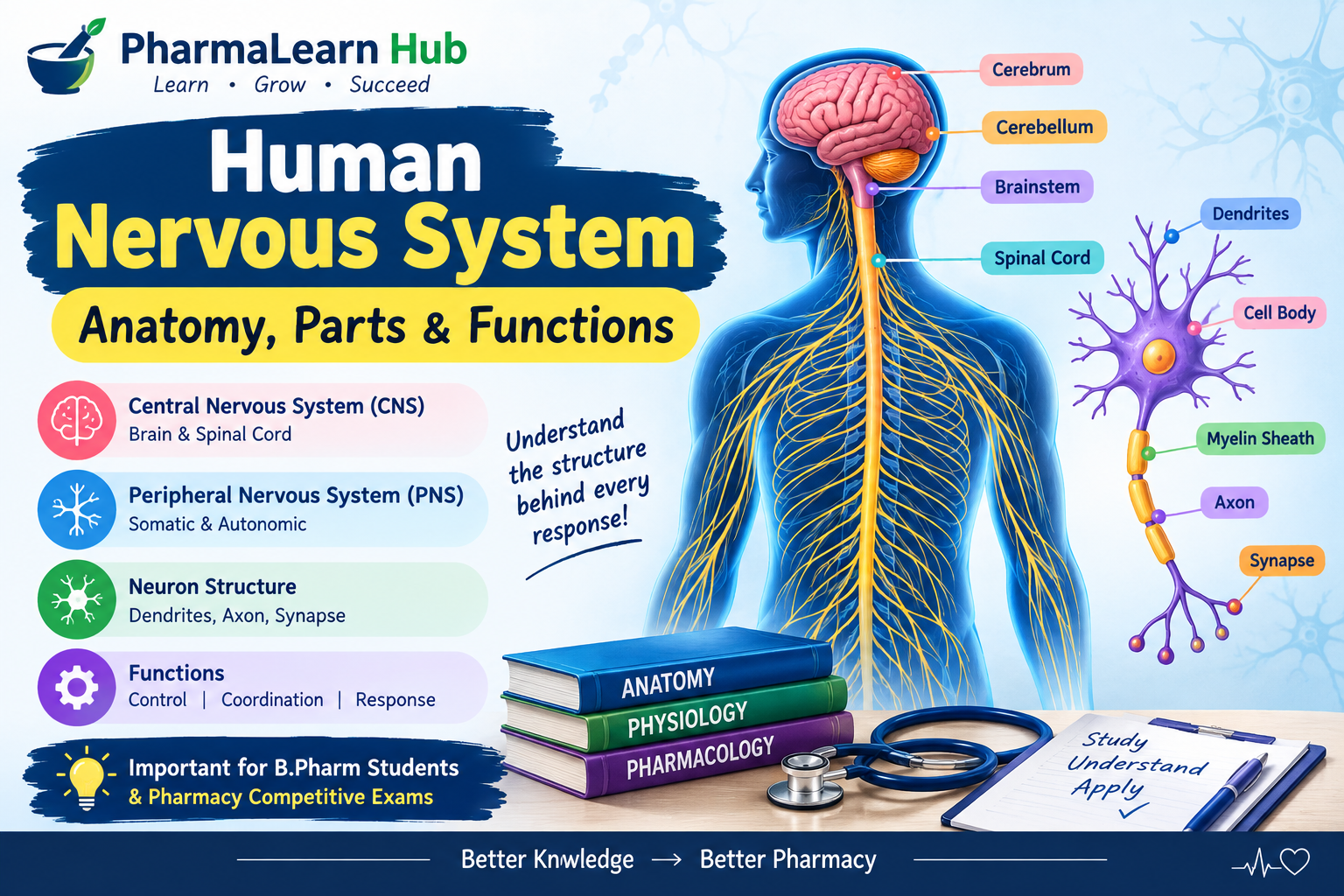
The brain can be broadly divided into the cerebrum, cerebellum, and brainstem.
Cerebrum
The cerebrum is the largest part of the brain. It is responsible for higher mental functions.
Important functions include:
- Thinking
- Memory
- Intelligence
- Learning
- Conscious sensation
- Voluntary movements
- Speech
The cerebrum is divided into two hemispheres:
- Right cerebral hemisphere
- Left cerebral hemisphere
These hemispheres are connected by a large bundle of nerve fibers called the corpus callosum.
Lobes of the Cerebrum
The cerebral cortex is divided into several important lobes.
Frontal Lobe:
Associated with voluntary movement, reasoning, planning, personality, and speech.
Parietal Lobe:
Processes sensations such as touch, pressure, pain, and temperature.
Temporal Lobe:
Important for hearing, memory, and understanding language.
Occipital Lobe:
Mainly involved in visual processing.
Cerebellum
The cerebellum is located at the back of the brain, below the cerebrum.
Its major functions include:
- Maintaining balance
- Coordinating movements
- Maintaining posture
- Controlling muscle coordination
- Helping produce smooth and accurate movements
Damage to the cerebellum can result in problems with balance and coordination.
Brainstem
The brainstem connects the brain with the spinal cord.
It consists mainly of:
- Midbrain
- Pons
- Medulla oblongata
The brainstem controls several essential functions such as breathing, heart rate, and blood pressure.
The medulla oblongata contains important centers involved in involuntary functions such as respiration and cardiovascular activity.
2. Spinal Cord
The spinal cord is a long cylindrical structure that extends from the brainstem through the vertebral column.
It serves as an important communication pathway between the brain and the rest of the body.
The spinal cord performs two major functions:
Sensory Function
It carries sensory information from the body toward the brain.
Motor Function
It carries motor signals from the brain to muscles and other organs.
The spinal cord also acts as a center for many reflex actions.
3. Peripheral Nervous System (PNS)
The peripheral nervous system consists of nerves and structures located outside the brain and spinal cord.
It connects the CNS with the rest of the body.
The PNS can be divided into:
- Somatic nervous system
- Autonomic nervous system
Somatic Nervous System
The somatic nervous system is mainly responsible for voluntary activities.
It controls skeletal muscles and carries sensory information from the skin, muscles, and joints to the CNS.
For example, when a person decides to move their hand, the somatic nervous system helps control the required skeletal muscles.
🧬Autonomic Nervous System
The autonomic nervous system (ANS) controls many involuntary functions of the body.
It regulates organs such as:
- Heart
- Blood vessels
- Lungs
- Digestive tract
- Urinary bladder
- Glands
The autonomic nervous system is mainly divided into:
1. Sympathetic Nervous System
The sympathetic nervous system is generally associated with the “fight or flight” response.
Its effects may include:
- Increased heart rate
- Increased cardiac activity
- Dilation of pupils
- Reduced digestive activity
- Increased blood flow to skeletal muscles
2. Parasympathetic Nervous System
The parasympathetic nervous system is generally associated with “rest and digest” activities.
Its effects may include:
- Decreased heart rate
- Increased digestive activity
- Constriction of pupils
- Increased salivation
- Promotion of normal digestive functions
3. Enteric Nervous System
The enteric nervous system is associated mainly with the gastrointestinal tract.
It helps regulate:
- Intestinal movement
- Secretion
- Blood flow within the digestive system
- Gastrointestinal functions
📍Neuron: The Functional Unit of the Nervous System
A neuron is a specialized cell that receives and transmits nerve impulses.
The major parts of a neuron are:
Cell Body
The cell body contains the nucleus and other important cellular structures.
Dendrites
Dendrites receive signals from other neurons or receptors and carry them toward the cell body.
Axon
The axon carries nerve impulses away from the cell body.
Myelin Sheath
The myelin sheath is a protective covering around many axons. It helps increase the speed of nerve impulse transmission.
Synapse
A synapse is the junction where communication occurs between neurons or between a neuron and another cell.
Chemical messengers called neurotransmitters are commonly involved in this communication.
Important neurotransmitters include:
- Acetylcholine
- Dopamine
- Serotonin
- Noradrenaline
- GABA
- Glutamate
✒️Reflex Action
A reflex action is a rapid and automatic response to a stimulus.
For example, quickly withdrawing the hand after touching a hot object is a reflex response.
The basic pathway involved is called the reflex arc.
A reflex arc generally involves:
Receptor → Sensory Neuron → CNS → Motor Neuron → Effector
Reflex actions help protect the body from potentially harmful stimuli.
📑Importance of the Nervous System in Pharmacy
The nervous system is highly important in pharmacology because many drugs act on the CNS and PNS.
Examples include:
- Analgesics
- Antidepressants
- Antipsychotic drugs
- Antiepileptic drugs
- Sedatives and hypnotics
- Anesthetics
- Cholinergic drugs
- Adrenergic drugs
Understanding the anatomy and organization of the nervous system helps pharmacy students understand drug mechanisms of action, therapeutic effects, and adverse effects.
📝Quick Revision Points
• CNS = Brain + Spinal Cord
• PNS = Nerves outside the CNS
• Cerebrum = Higher mental functions
• Cerebellum = Balance and coordination
• Medulla = Important involuntary functions
• Somatic Nervous System = Mainly voluntary control
• Autonomic Nervous System = Mainly involuntary control
• Sympathetic Nervous System = Fight or flight
• Parasympathetic Nervous System = Rest and digest
• Neuron = Structural and functional unit of the nervous system
📋Frequently Asked Questions
1.What are the two main divisions of the nervous system?
The nervous system is divided into the central nervous system (CNS) and peripheral nervous system (PNS).
2.What are the components of the CNS?
The CNS consists of the brain and spinal cord.
3.What is the main function of the cerebellum?
The cerebellum mainly helps maintain balance, posture, and coordination of movements.
4.What is the basic unit of the nervous system?
The neuron is the basic structural and functional unit of the nervous system.
5.What is the difference between the sympathetic and parasympathetic nervous systems?
The sympathetic system generally prepares the body for activity or stress, whereas the parasympathetic system supports rest, digestion, and routine body functions.
🎯Conclusion
The human nervous system is a complex control and communication system that coordinates the activities of the entire body. The brain and spinal cord form the CNS, while the PNS connects the CNS with different parts of the body.
Understanding the cerebrum, cerebellum, brainstem, spinal cord, neurons, and autonomic nervous system is essential for pharmacy students because many drugs produce their effects by acting on the nervous system.
For B.Pharm students, a strong understanding of nervous system anatomy provides a useful foundation for studying CNS pharmacology, autonomic pharmacology, neuropharmacology, and related pharmaceutical subjects.
1 thought on “Human Nervous System: Anatomy, Parts & Functions”