📌 Introduction
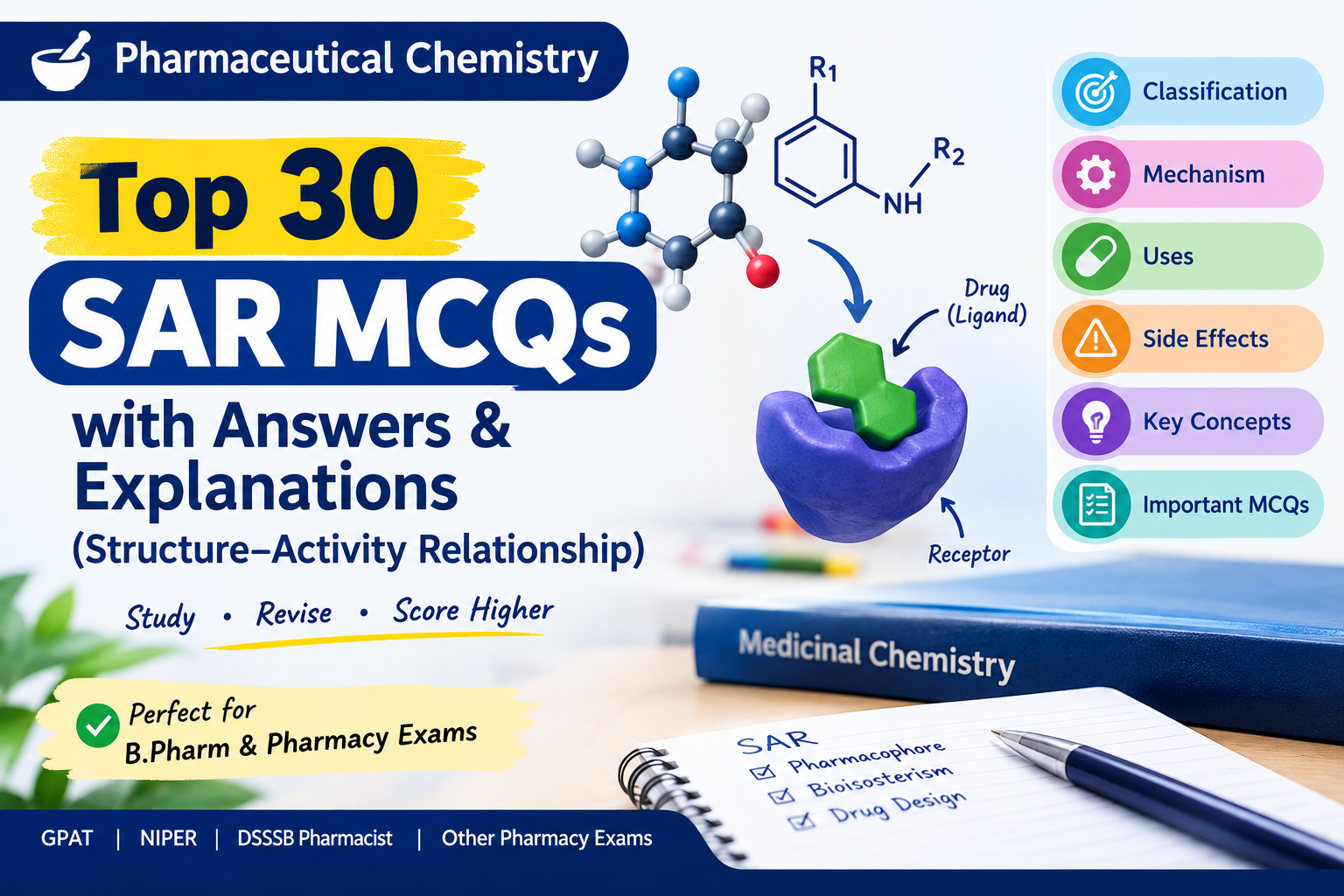
Structure–Activity Relationship (SAR) is an important topic in pharmaceutical chemistry and medicinal chemistry. It explains how changes in the chemical structure of a drug can affect its biological activity, potency, selectivity, pharmacokinetic properties and toxicity.
These 30 important SAR MCQs are useful for B.Pharm students and pharmacy competitive examinations such as GPAT, NIPER, DSSSB Pharmacist and other pharmacy exams.
📚 30 Important MCQs on Structure–Activity Relationship (SAR)
1. What does SAR stand for?
A. Structural Action Reaction
B. Structure–Activity Relationship
C. Synthetic Activity Reaction
D. Structure Absorption Rate
Correct Answer: B. Structure–Activity Relationship
Explanation: SAR is the study of the relationship between the chemical structure of a compound and its biological or pharmacological activity.
2. SAR is mainly studied in which field?
A. Pharmacognosy
B. Medicinal Chemistry
C. Anatomy
D. Physiology
Correct Answer: B. Medicinal Chemistry
Explanation: SAR is a fundamental concept of medicinal chemistry used to understand and optimize drug structures.
3. The main purpose of SAR studies is to:
A. Determine blood pressure
B. Study drug packaging
C. Understand how structural changes affect biological activity
D. Measure tablet hardness
Correct Answer: C. Understand how structural changes affect biological activity
Explanation: SAR studies help identify structural features responsible for drug activity and guide the optimization of drug molecules.
4. Which of the following can be affected by structural modification of a drug?
A. Potency
B. Selectivity
C. Toxicity
D. All of the above
Correct Answer: D. All of the above
Explanation: Structural changes can influence potency, selectivity, toxicity, absorption, metabolism and other drug properties.
5. Which part of a drug molecule may participate directly in drug–receptor interactions?
A. Functional group
B. Packaging material
C. Tablet coating only
D. Label
Correct Answer: A. Functional group
Explanation: Functional groups such as hydroxyl, amino, carboxyl and other groups can participate in interactions with biological targets.
6. Which property describes the tendency of a compound to dissolve in fats or non-polar environments?
A. Hydrophilicity
B. Lipophilicity
C. Acidity
D. Ionization
Correct Answer: B. Lipophilicity
Explanation: Lipophilicity is the tendency of a molecule to partition into lipid or non-polar environments.
7. Lipophilicity can influence:
A. Membrane penetration
B. Distribution
C. Protein binding
D. All of the above
Correct Answer: D. All of the above
Explanation: Lipophilicity can affect membrane permeability, distribution, protein binding and other pharmacokinetic properties.
8. Which of the following is an important consideration in drug–receptor interaction?
A. Molecular shape
B. Molecular size
C. Functional groups
D. All of the above
Correct Answer: D. All of the above
Explanation: Molecular shape, size and functional groups can all influence how a drug interacts with its biological target.
9. The lock-and-key concept is commonly used to explain:
A. Drug packaging
B. Drug–receptor interaction
C. Drug manufacturing
D. Tablet disintegration
Correct Answer: B. Drug–receptor interaction
Explanation: The lock-and-key concept illustrates how a drug molecule may fit into a complementary receptor binding site.
10. Which of the following refers to the three-dimensional arrangement of atoms in a molecule?
A. Stereochemistry
B. Solubility
C. Acidity
D. Molecular weight
Correct Answer: A. Stereochemistry
Explanation: Stereochemistry deals with the spatial arrangement of atoms in molecules.
11. Different stereoisomers of a drug may have different:
A. Pharmacological activities
B. Receptor affinities
C. Toxicities
D. All of the above
Correct Answer: D. All of the above
Explanation: Because biological targets are three-dimensional, different stereoisomers can interact differently with receptors and enzymes.
12. What is a pharmacophore?
A. The complete chemical name of a drug
B. Essential structural and electronic features required for biological activity
C. A drug formulation
D. A pharmaceutical excipient
Correct Answer: B. Essential structural and electronic features required for biological activity
Explanation: A pharmacophore represents the essential features of a molecule needed for interaction with a biological target and production of a biological effect.
13. Which of the following can be a pharmacophore feature?
A. Hydrogen-bond donor
B. Hydrogen-bond acceptor
C. Hydrophobic region
D. All of the above
Correct Answer: D. All of the above
Explanation: Pharmacophores can contain hydrogen-bond donors, hydrogen-bond acceptors, hydrophobic regions, aromatic features and charged groups.
14. Bioisosterism is mainly used to:
A. Modify drug properties while attempting to retain biological activity
B. Increase tablet weight
C. Change the color of tablets
D. Measure drug hardness
Correct Answer: A. Modify drug properties while attempting to retain biological activity
Explanation: Bioisosteric replacement can be used to modify potency, toxicity, stability or pharmacokinetic properties while maintaining desired activity.
15. Which of the following is an objective of bioisosteric replacement?
A. Improve metabolic stability
B. Reduce toxicity
C. Modify pharmacokinetic properties
D. All of the above
Correct Answer: D. All of the above
Explanation: Bioisosterism can be used to optimize several drug properties, including metabolic stability, toxicity and pharmacokinetics.
16. SAR is particularly useful during:
A. Drug discovery and optimization
B. Tablet counting
C. Pharmacy store management
D. Prescription printing
Correct Answer: A. Drug discovery and optimization
Explanation: SAR helps researchers optimize lead compounds and identify structural changes that improve desired biological properties.
17. A compound selected for further structural optimization during drug discovery is commonly called a:
A. Lead compound
B. Excipient
C. Preservative
D. Diluent
Correct Answer: A. Lead compound
Explanation: A lead compound is a promising molecule that can be structurally modified and optimized during drug development.
18. Which sequence best represents a simplified SAR-based drug optimization process?
A. Lead compound → Structural modification → SAR study → Optimization
B. Tablet → Packaging → SAR → Injection
C. Prescription → Packaging → SAR → Dispensing
D. Excipient → Tablet → SAR → Label
Correct Answer: A. Lead compound → Structural modification → SAR study → Optimization
Explanation: Researchers modify lead compounds and compare their biological activities to identify more effective drug candidates.
19. Which group is an example of a common functional group found in drug molecules?
A. Hydroxyl group
B. Amino group
C. Carboxylic acid group
D. All of the above
Correct Answer: D. All of the above
Explanation: Hydroxyl, amino and carboxylic acid groups are common functional groups that can influence drug properties and biological interactions.
20. Electron-donating and electron-withdrawing groups primarily influence the:
A. Electronic properties of a molecule
B. Tablet size
C. Packaging
D. Color of a formulation
Correct Answer: A. Electronic properties of a molecule
Explanation: Electron-donating and electron-withdrawing substituents can alter the electronic distribution, polarity, acidity/basicity and reactivity of a molecule.
21. Which property is important for the ability of many drugs to cross biological membranes?
A. Lipophilicity
B. Tablet color
C. Packaging size
D. Label design
Correct Answer: A. Lipophilicity
Explanation: Lipophilicity is an important factor influencing the ability of many drug molecules to partition into and cross lipid membranes.
22. A pharmacophore represents:
A. All atoms in every drug molecule
B. Essential features responsible for biological interaction
C. Only the molecular weight
D. Only the drug’s melting point
Correct Answer: B. Essential features responsible for biological interaction
Explanation: A pharmacophore focuses on the essential spatial and electronic features required for biological activity rather than necessarily representing the entire molecule.
23. Which of the following can be improved through rational structural modification?
A. Potency
B. Selectivity
C. Metabolic stability
D. All of the above
Correct Answer: D. All of the above
Explanation: Rational structural modifications are used to optimize potency, selectivity, stability, pharmacokinetics and safety.
24. Why is molecular shape important in SAR?
A. It can influence binding to the biological target
B. It determines tablet color
C. It determines package size
D. It determines prescription format
Correct Answer: A. It can influence binding to the biological target
Explanation: The three-dimensional shape of a molecule influences how well it fits and interacts with a receptor or enzyme.
25. Which concept deals specifically with replacement of a chemical group by another group with similar properties?
A. Bioisosterism
B. Filtration
C. Distillation
D. Extraction
Correct Answer: A. Bioisosterism
Explanation: Bioisosterism involves replacing an atom or group with another suitable group to alter molecular properties while attempting to retain biological activity.
26. SAR can help reduce:
A. Drug toxicity
B. Drug selectivity
C. Drug stability
D. Biological activity in every case
Correct Answer: A. Drug toxicity
Explanation: Structural optimization can sometimes reduce unwanted toxicity while maintaining or improving the desired pharmacological effect.
27. Which of the following is most closely associated with medicinal chemistry?
A. Drug design
B. SAR studies
C. Optimization of lead compounds
D. All of the above
Correct Answer: D. All of the above
Explanation: Medicinal chemistry involves designing, modifying and optimizing chemical compounds to develop useful therapeutic agents.
28. Which statement about SAR is correct?
A. A small structural change can sometimes produce a significant change in biological activity
B. Chemical structure never affects drug activity
C. SAR is only used for tablet manufacturing
D. SAR has no role in drug discovery
Correct Answer: A. A small structural change can sometimes produce a significant change in biological activity
Explanation: Even a small change in a functional group, substituent or stereochemistry can significantly alter potency, selectivity or other properties.
29. Which topic is directly related to SAR?
A. Pharmacophore
B. Bioisosterism
C. Stereochemistry
D. All of the above
Correct Answer: D. All of the above
Explanation: Pharmacophore analysis, bioisosterism and stereochemistry are important concepts used in understanding and applying SAR.
30. The ultimate goal of SAR-based drug optimization is to develop a compound with:
A. Desired biological activity and suitable drug properties
B. Maximum molecular weight only
C. Maximum lipophilicity only
D. No chemical structure
Correct Answer: A. Desired biological activity and suitable drug properties
Explanation: SAR-based optimization aims to obtain drug candidates with desirable activity, selectivity, safety and pharmacokinetic characteristics.
📝 Quick Revision: SAR
Before your pharmacy exam, remember these key points:
- SAR = Structure–Activity Relationship
- SAR connects chemical structure with biological activity.
- Functional groups can influence drug activity.
- Molecular size and shape affect drug–target interactions.
- Lipophilicity influences membrane penetration and distribution.
- Stereochemistry can affect receptor binding and pharmacological activity.
- A pharmacophore represents essential features required for biological activity.
- Bioisosterism is used to modify drug properties while attempting to retain desired activity.
- SAR is an important tool in medicinal chemistry and drug discovery.
- SAR helps optimize potency, selectivity, safety and pharmacokinetic properties.
🎯 Conclusion
Structure–Activity Relationship is a fundamental concept in pharmaceutical and medicinal chemistry. Understanding SAR helps pharmacy students recognize how changes in a drug’s chemical structure can influence its biological activity, potency, selectivity, pharmacokinetics and toxicity.
These MCQs provide a quick way to revise important SAR concepts and prepare for pharmacy examinations. Regular practice of concept-based MCQs can help students strengthen their understanding and improve their performance in competitive exams.
📚 Keep practicing and keep learning!