
📌Introduction
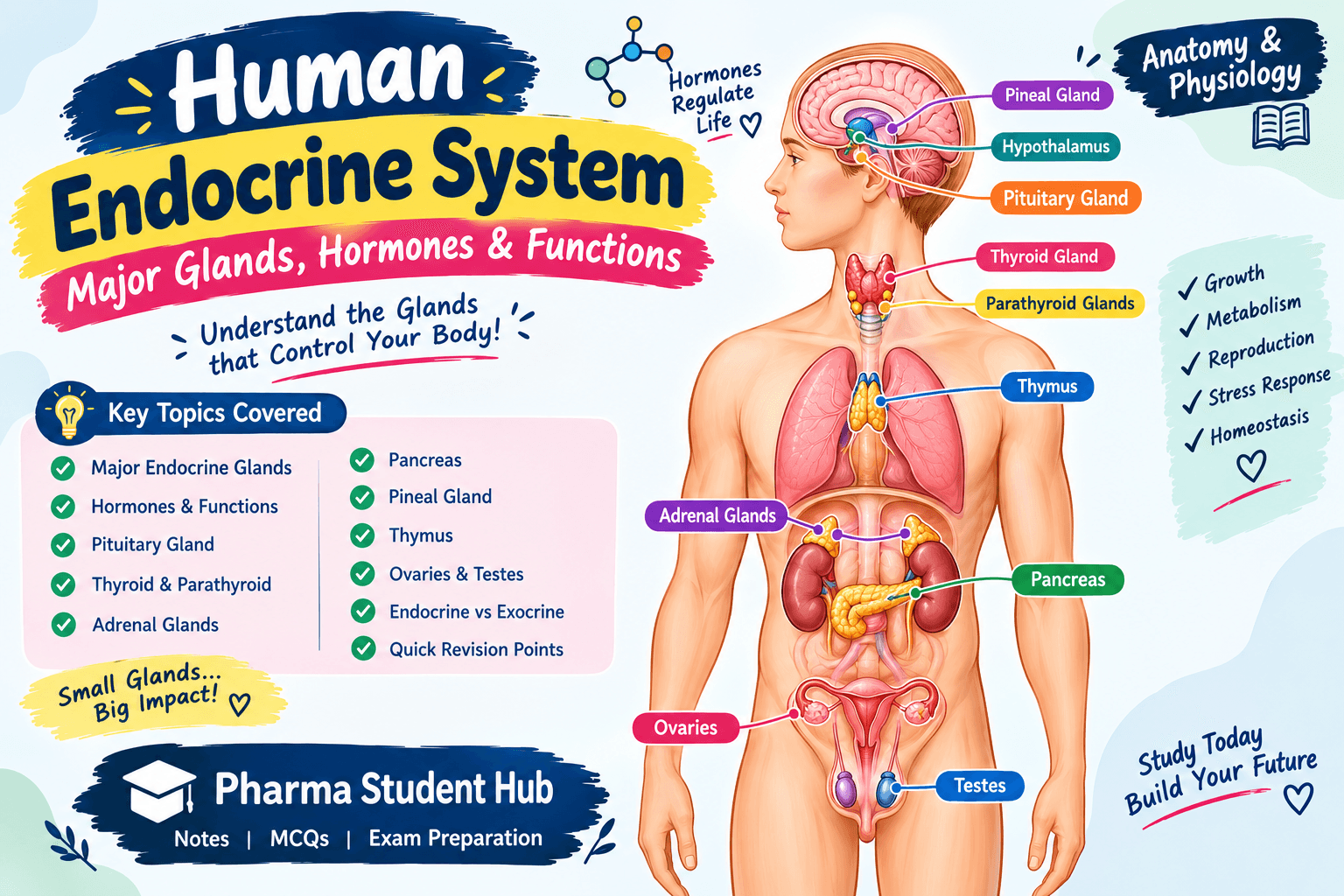
The human endocrine system is an important system that helps control and coordinate many activities of the body. It consists of specialized glands that produce and release chemical messengers called hormones.
Hormones travel through the blood to specific target cells or organs and regulate functions such as growth, metabolism, reproduction, stress response, water balance, and blood glucose levels.
For pharmacy students, understanding the endocrine system is essential because many important medicines act on hormones, endocrine glands, or their receptors.
🔍What is the Endocrine System?
The endocrine system is a collection of glands and specialized tissues that produce and secrete hormones directly into the bloodstream.
Unlike exocrine glands, endocrine glands generally do not have ducts.
Important endocrine glands and organs include:
- Hypothalamus
- Pituitary gland
- Thyroid gland
- Parathyroid glands
- Adrenal glands
- Pancreas
- Pineal gland
- Thymus
- Ovaries
- Testes
📍What are Hormones?
Hormones are chemical messengers produced by endocrine cells.
They travel through the bloodstream and act on specific target cells or tissues.
Hormones help regulate:
- Growth and development
- Metabolism
- Blood glucose
- Water and electrolyte balance
- Reproduction
- Sexual development
- Stress responses
- Calcium balance
- Sleep-wake cycles
1. Hypothalamus
The hypothalamus is a small region of the brain located below the thalamus.
It provides an important connection between the nervous and endocrine systems.
The hypothalamus produces regulatory hormones that control the activity of the pituitary gland.
It also produces:
- Antidiuretic hormone (ADH)
- Oxytocin
ADH and oxytocin are synthesized in the hypothalamus and stored and released from the posterior pituitary.
The hypothalamus also plays important roles in:
- Body temperature regulation
- Hunger and thirst
- Water balance
- Sleep-wake regulation
- Endocrine regulation
2. Pituitary Gland
The pituitary gland is a small endocrine gland located at the base of the brain.
It is often called the master gland because it regulates several other endocrine glands, although its activity is itself controlled by the hypothalamus.
The pituitary gland has two major parts:
- Anterior pituitary
- Posterior pituitary
Anterior Pituitary
The anterior pituitary produces several important hormones.
Growth Hormone (GH)
Growth hormone promotes growth and influences metabolism.
Thyroid-Stimulating Hormone (TSH)
TSH stimulates the thyroid gland to produce thyroid hormones.
Adrenocorticotropic Hormone (ACTH)
ACTH stimulates the adrenal cortex, particularly influencing glucocorticoid secretion.
Follicle-Stimulating Hormone (FSH)
FSH plays important roles in reproductive function.
Luteinizing Hormone (LH)
LH is involved in ovulation and reproductive hormone production.
Prolactin
Prolactin promotes milk production after childbirth.
Posterior Pituitary
The posterior pituitary stores and releases:
- ADH
- Oxytocin
ADH helps regulate water balance by increasing water reabsorption in the kidneys.
Oxytocin is involved in uterine contractions and milk ejection.
3. Thyroid Gland
The thyroid gland is located in the neck, in front of the trachea.
It produces:
- Thyroxine (T4)
- Triiodothyronine (T3)
- Calcitonin
Thyroid Hormones
T3 and T4 play important roles in:
- Regulation of metabolism
- Growth
- Development
- Energy production
Calcitonin
Calcitonin is produced by thyroid parafollicular cells.
It participates in calcium regulation and generally lowers blood calcium concentration by reducing bone resorption.
4. Parathyroid Glands
The parathyroid glands are usually four small glands located on the posterior surface of the thyroid gland.
They produce parathyroid hormone (PTH).
PTH plays a major role in maintaining calcium and phosphate balance.
Its major effects include increasing blood calcium levels through actions on bone, kidneys, and indirectly the intestine.
5. Adrenal Glands
The adrenal glands are located on top of the kidneys.
Each adrenal gland has two major regions:
- Adrenal cortex
- Adrenal medulla
Adrenal Cortex
The adrenal cortex produces steroid hormones including:
- Cortisol
- Aldosterone
- Adrenal androgens
Cortisol
Cortisol helps the body respond to stress and influences metabolism and immune function.
Aldosterone
Aldosterone helps regulate sodium and potassium balance and contributes to blood pressure regulation.
Adrenal Medulla
The adrenal medulla produces:
- Epinephrine
- Norepinephrine
These hormones are important in the body’s response to stress and sympathetic activation.
6. Pancreas
The pancreas has both endocrine and exocrine functions.
The endocrine portion contains clusters of cells called the islets of Langerhans.
Important pancreatic hormones include:
Insulin
Insulin lowers blood glucose by promoting glucose uptake and storage.
Glucagon
Glucagon increases blood glucose, particularly by promoting breakdown of stored glycogen and supporting glucose production.
Somatostatin
Somatostatin inhibits the secretion of several hormones and also influences gastrointestinal and pancreatic functions.
7. Pineal Gland
The pineal gland is a small endocrine structure located in the brain.
It produces melatonin.
Melatonin plays an important role in regulating the sleep-wake cycle and circadian rhythms.
8. Thymus
The thymus is located in the upper chest behind the sternum.
It is particularly important for the development and maturation of T lymphocytes (T cells), which are part of the immune system.
The thymus is more prominent and active during childhood and undergoes changes with age.
9. Ovaries
The ovaries are the female reproductive glands.
They produce important hormones such as:
- Estrogen
- Progesterone
Estrogen
Estrogen contributes to development of female reproductive organs and secondary sexual characteristics and plays important roles in the menstrual cycle and bone health.
Progesterone
Progesterone plays an important role in preparing and maintaining the uterus for pregnancy and in regulating the menstrual cycle.
10. Testes
The testes are the male reproductive glands.
They produce:
- Testosterone
- Inhibin
Testosterone
Testosterone is important for:
- Development of male reproductive organs
- Male secondary sexual characteristics
- Sperm production
- Maintenance of muscle and bone
💊Endocrine vs Exocrine Glands
| Endocrine Glands | Exocrine Glands |
|---|---|
| Release hormones into blood | Release secretions through ducts |
| Usually ductless | Usually have ducts |
| Examples: thyroid, pituitary | Examples: salivary glands, sweat glands |
| Produce hormones | Produce substances such as enzymes, sweat, or digestive secretions |
The pancreas has both endocrine and exocrine functions.
🖇️Hormonal Regulation and Feedback
Hormone secretion is often controlled by feedback mechanisms.
The most common mechanism is negative feedback.
In negative feedback, an increase in the final hormone or its physiological effect reduces further stimulation of hormone secretion.
For example, thyroid hormones participate in feedback regulation of the hypothalamus and pituitary to help maintain appropriate thyroid hormone levels.
Feedback mechanisms help maintain hormonal balance and homeostasis.
🧬Major Endocrine Glands and Their Hormones
Hypothalamus
Regulatory hormones, ADH, oxytocin
Pituitary Gland
GH, TSH, ACTH, FSH, LH, prolactin, ADH, oxytocin
Thyroid Gland
T3, T4, calcitonin
Parathyroid Glands
PTH
Adrenal Cortex
Cortisol, aldosterone, adrenal androgens
Adrenal Medulla
Epinephrine, norepinephrine
Pancreas
Insulin, glucagon, somatostatin
Pineal Gland
Melatonin
Ovaries
Estrogen, progesterone
Testes
Testosterone, inhibin
📑Importance of the Endocrine System in Pharmacy
The endocrine system is highly important in pharmacy because many medicines are designed to replace hormones, modify hormone production, or act on hormone receptors.
Important endocrine-related drug groups include:
- Insulin and other antidiabetic drugs
- Thyroid hormone preparations
- Antithyroid drugs
- Corticosteroids
- Hormonal contraceptives
- Sex hormones
- Drugs affecting adrenal hormones
- Drugs affecting calcium and bone metabolism
Understanding endocrine physiology helps pharmacy students understand the mechanisms, therapeutic uses, and adverse effects of these medicines.
✒️Common Endocrine Disorders
Disorders of the endocrine system can occur when a gland produces too much or too little hormone or when target tissues do not respond appropriately.
Examples include:
- Diabetes mellitus
- Hypothyroidism
- Hyperthyroidism
- Cushing syndrome
- Addison disease
- Hyperparathyroidism
- Growth hormone disorders
Understanding normal endocrine physiology is important for understanding these disorders and their treatment.
📝Quick Revision Points
📌 Endocrine glands generally release hormones into the bloodstream.
📌 Hypothalamus connects the nervous and endocrine systems.
📌 Pituitary gland produces and releases several important hormones.
📌 T3 and T4 are produced by the thyroid gland.
📌 PTH regulates calcium and phosphate balance.
📌 Adrenal glands are located above the kidneys.
📌 Adrenal cortex produces cortisol and aldosterone.
📌 Adrenal medulla produces epinephrine and norepinephrine.
📌 Insulin generally decreases blood glucose.
📌 Glucagon generally increases blood glucose.
📌 Pineal gland produces melatonin.
📌 Ovaries produce estrogen and progesterone.
📌 Testes produce testosterone.
📌 Negative feedback helps maintain hormonal homeostasis.
📋Frequently Asked Questions
1. What is the endocrine system?
The endocrine system is a group of glands and tissues that produce hormones and release them into the bloodstream to regulate various body functions.
2. Which gland is commonly called the master gland?
The pituitary gland is commonly called the master gland because it regulates several other endocrine glands. However, its activity is controlled by the hypothalamus.
3. Which hormone lowers blood glucose?
Insulin is the major hormone that lowers blood glucose by promoting glucose uptake and storage.
4. Which gland produces thyroid hormones?
The thyroid gland produces T3 and T4.
5. Which hormone regulates blood calcium levels?
Parathyroid hormone (PTH) is a major regulator of blood calcium concentration.
6. Which gland produces melatonin?
The pineal gland produces melatonin, which helps regulate circadian rhythms and the sleep-wake cycle.
🎯Conclusion
The endocrine system is an essential regulatory system that controls many important physiological processes through hormones. The hypothalamus, pituitary, thyroid, parathyroid, adrenal glands, pancreas, pineal gland, thymus, ovaries, and testes all contribute to endocrine regulation.
For pharmacy students, understanding endocrine anatomy and physiology provides an important foundation for studying endocrinology and pharmacology, particularly topics such as diabetes, thyroid disorders, corticosteroids, hormonal contraception, and other hormone-related therapies.
A clear understanding of the major endocrine glands, their hormones, and their functions can make the study of endocrine pharmacology much easier and more systematic.