
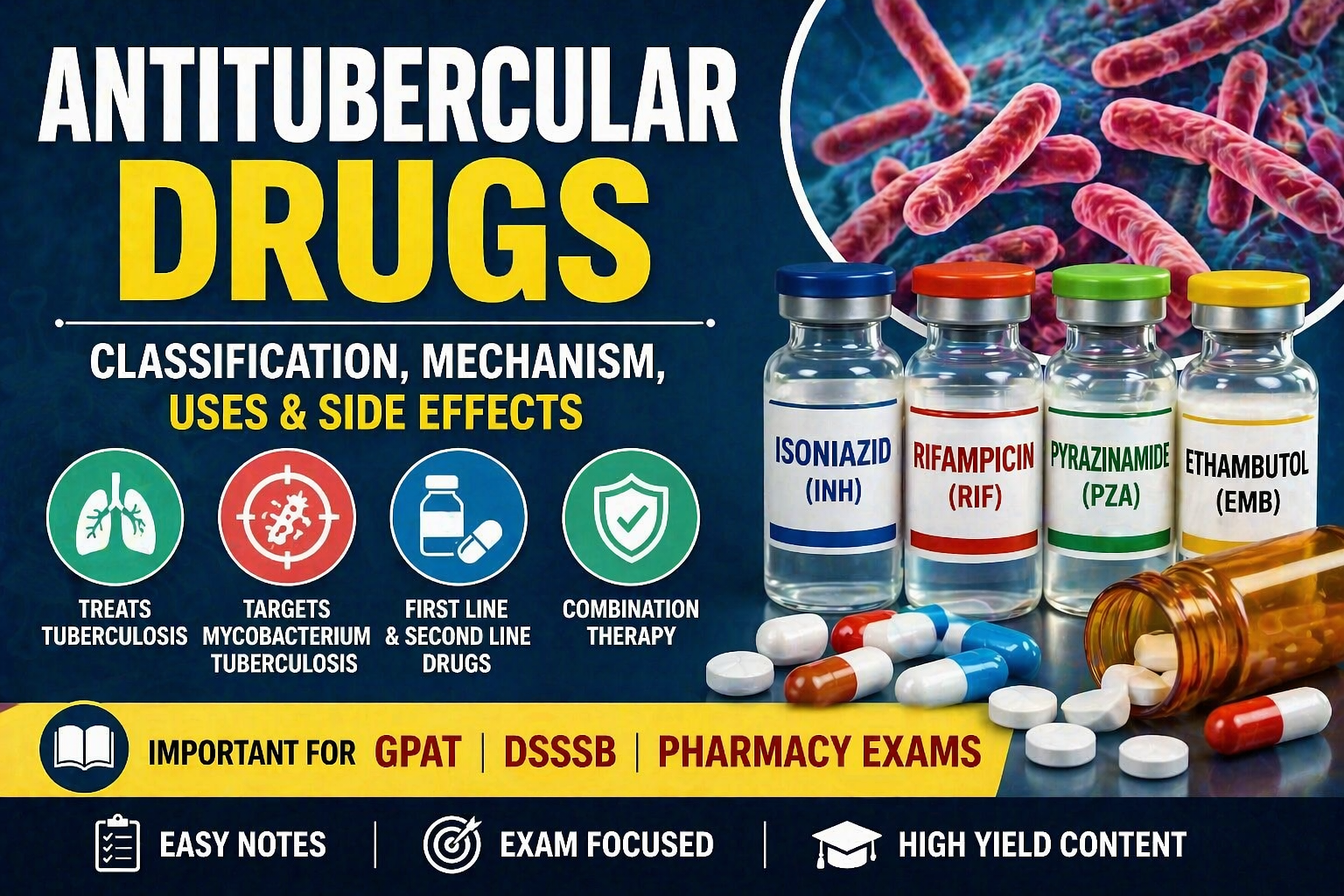
Antitubercular drugs are medicines used to treat tuberculosis (TB), an infectious disease caused mainly by Mycobacterium tuberculosis. These medicines are an important topic in pharmacology for B.Pharm, D.Pharm, GPAT, and pharmacist recruitment examinations.
Understanding the classification, mechanism of action, therapeutic uses, and adverse effects of antitubercular drugs helps students prepare for examinations and build a strong foundation in pharmacology.
🔍What Is Tuberculosis?
Tuberculosis is an infectious disease caused by Mycobacterium tuberculosis. It most commonly affects the lungs but can also affect the lymph nodes, bones, kidneys, brain, and other organs.
TB spreads through the air when a person with infectious pulmonary or laryngeal TB releases bacteria-containing particles.
Types of Tuberculosis
- Pulmonary TB: Tuberculosis affecting the lungs.
- Extrapulmonary TB: Tuberculosis affecting organs outside the lungs.
- Latent TB infection: The bacteria remain in the body without causing active disease or symptoms, and the person is not infectious from latent infection alone.
- Drug-resistant TB: Tuberculosis caused by bacteria resistant to one or more antitubercular medicines.
📝Classification of Antitubercular Drugs
Antitubercular drugs can be classified according to their role in treatment and their mechanism of action. The choice of medicines depends on drug susceptibility, the type of TB, patient characteristics, and current treatment guidelines.
1. Important First-Line Drugs
The four classic first-line drugs commonly taught in pharmacology are:
- Isoniazid (H): Inhibits mycolic acid synthesis.
- Rifampicin (R): Inhibits bacterial DNA-dependent RNA polymerase.
- Pyrazinamide (Z): Converted to pyrazinoic acid; its precise mechanism is not completely understood.
- Ethambutol (E): Inhibits arabinogalactan synthesis in the mycobacterial cell wall.
These drugs are frequently discussed together in pharmacology textbooks and examination questions.
2. Other Important Antitubercular Drugs
Medicines used in selected drug-resistant TB regimens or particular clinical situations include:
- Bedaquiline
- Linezolid
- Levofloxacin
- Moxifloxacin
- Clofazimine
- Cycloserine
- Delamanid
- Pretomanid
- Amikacin in selected circumstances
These medicines are not interchangeable. Treatment selection requires specialist assessment and consideration of drug susceptibility, adverse effects, and current guidelines.
⚕️Mechanism of Action of Antitubercular Drugs
1. Isoniazid
Isoniazid is a prodrug activated by the mycobacterial KatG enzyme. Its active form inhibits InhA, disrupting mycolic acid synthesis.
Mycolic acids are essential components of the mycobacterial cell wall. Inhibiting their production weakens the cell envelope and interferes with bacterial survival.
Important exam point: Isoniazid inhibits mycolic acid synthesis.
Major adverse effects: Hepatotoxicity and peripheral neuropathy.
2. Rifampicin
Rifampicin inhibits bacterial DNA-dependent RNA polymerase. This prevents RNA synthesis and interferes with bacterial protein production.
It is an important component of combination treatment for drug-susceptible TB.
Important exam point: Rifampicin inhibits DNA-dependent RNA polymerase.
Major adverse effects: Hepatotoxicity, orange-red discoloration of body fluids, and numerous drug interactions because it induces drug-metabolizing enzymes.
3. Pyrazinamide
Pyrazinamide is converted into pyrazinoic acid by mycobacterial enzymes. Its activity is influenced by the acidic conditions found in certain infected tissues.
Its precise mechanism is not fully understood, but it disrupts important processes in mycobacterial physiology.
Important exam point: Pyrazinamide is particularly useful as part of the initial treatment phase of many drug-susceptible TB regimens.
Major adverse effects: Hepatotoxicity, nausea, and hyperuricemia.
4. Ethambutol
Ethambutol inhibits arabinosyltransferase enzymes involved in synthesizing arabinogalactan, a component of the mycobacterial cell wall.
This interferes with the formation and maintenance of the bacterial cell envelope.
Important exam point: Ethambutol can cause optic neuritis and changes in visual acuity or colour vision.
Major adverse effects: Optic toxicity and, in some patients, elevated uric acid levels.
5. Bedaquiline
Bedaquiline inhibits mycobacterial ATP synthase, interfering with the production of energy required for bacterial survival.
It is used in selected drug-resistant TB treatment regimens.
Important exam point: Bedaquiline inhibits ATP synthase.
Major safety concern: QT interval prolongation and potential cardiac rhythm disturbances.
6. Linezolid
Linezolid inhibits bacterial protein synthesis by binding to the 50S ribosomal subunit and interfering with formation of the initiation complex.
It may be used in selected drug-resistant TB regimens.
Major adverse effects: Bone marrow suppression and peripheral or optic neuropathy, particularly with prolonged treatment.
Comparison of Important Antitubercular Drugs
| Drug | Main mechanism | Important adverse effect |
|---|---|---|
| Isoniazid | Inhibits mycolic acid synthesis | Peripheral neuropathy, hepatotoxicity |
| Rifampicin | Inhibits DNA-dependent RNA polymerase | Orange-red body fluids, hepatotoxicity, drug interactions |
| Pyrazinamide | Mechanism incompletely understood; converted to pyrazinoic acid | Hyperuricemia, hepatotoxicity |
| Ethambutol | Inhibits arabinosyltransferase | Optic toxicity |
| Bedaquiline | Inhibits ATP synthase | QT prolongation |
| Linezolid | Inhibits bacterial protein synthesis | Bone marrow suppression, neuropathy |
| Levofloxacin | Inhibits DNA gyrase and topoisomerase IV | Tendon injury and other fluoroquinolone-related adverse effects |
| Amikacin | Inhibits the 30S ribosomal subunit | Ototoxicity and nephrotoxicity |
🩺Therapeutic Uses of Antitubercular Drugs
Antitubercular medicines are used in several clinical situations.
1. Drug-Susceptible Active TB
Active tuberculosis is treated with a combination of medicines selected according to the patient’s condition and applicable treatment guidelines. Combination therapy helps improve treatment effectiveness and reduce the risk of resistance.
2. Extrapulmonary TB
TB affecting organs outside the lungs may require treatment adapted to the affected site, disease severity, and other clinical factors.
3. Latent TB Infection
Preventive treatment can reduce the risk of developing active TB. The regimen depends on factors such as drug susceptibility, other medicines being taken, and the patient’s clinical situation.
4. Drug-Resistant TB
Drug-resistant TB requires an appropriately selected regimen based on resistance testing, previous treatment, and specialist guidance. Some patients may require newer medicines such as bedaquiline or linezolid.
📍Important Adverse Effects and Precautions
Antitubercular medicines can cause adverse effects that require appropriate counselling and monitoring.
- Isoniazid: Peripheral neuropathy and liver injury.
- Rifampicin: Orange-red discoloration of urine, tears, and other body fluids; liver injury and drug interactions.
- Pyrazinamide: Hyperuricemia and liver injury.
- Ethambutol: Visual changes and optic neuritis.
- Bedaquiline: QT interval prolongation.
- Linezolid: Blood cell abnormalities and neuropathy.
Depending on the regimen and individual risk factors, monitoring may include liver function tests, blood counts, visual assessment, kidney function, or electrocardiography.
Patients should not stop, change, or combine TB medicines on their own. Incomplete or inappropriate treatment can contribute to treatment failure and drug resistance.
📑High-Yield Exam Points
- Isoniazid inhibits mycolic acid synthesis.
- Rifampicin inhibits DNA-dependent RNA polymerase.
- Ethambutol inhibits arabinogalactan synthesis.
- Pyrazinamide is converted into pyrazinoic acid.
- Bedaquiline inhibits ATP synthase.
- Linezolid inhibits bacterial protein synthesis.
- Rifampicin can cause orange-red discoloration of body fluids.
- Isoniazid can cause peripheral neuropathy.
- Ethambutol can cause optic toxicity.
- TB treatment requires an appropriate regimen and careful attention to drug resistance.
📋Frequently Asked Questions
1. What are antitubercular drugs?
Antitubercular drugs are medicines used to treat tuberculosis caused by Mycobacterium tuberculosis. They are selected according to the type of TB, drug susceptibility, and applicable treatment guidelines.
2. What are the four classic first-line antitubercular drugs?
The four classic drugs commonly taught together are isoniazid, rifampicin, pyrazinamide, and ethambutol.
3. Which antitubercular drug causes orange-red discoloration of body fluids?
Rifampicin can cause orange-red discoloration of urine, tears, sweat, and other body fluids.
4. Which antitubercular drug can cause optic neuritis?
Ethambutol can cause optic toxicity, including optic neuritis and changes in colour vision.
5. Why are multiple drugs used to treat tuberculosis?
Combination treatment improves the chance of successful treatment and helps prevent the development of drug resistance.
6. Which antitubercular drug inhibits ATP synthase?
Bedaquiline inhibits mycobacterial ATP synthase.
7. Which antitubercular drugs should be taken on an empty stomach?
Rifampicin and isoniazid are generally best absorbed when taken on an empty stomach, usually 1 hour before or 2 hours after a meal. However, the exact instructions may depend on the prescribed formulation and treatment regimen.
🎯 Conclusion
Antitubercular drugs are an important topic in pharmacology and pharmacy examinations. Students should focus on the classification, mechanisms of action, major adverse effects, and distinguishing features of each drug.
For exam preparation, revise the high-yield points and practise MCQs regularly to strengthen your understanding.
Disclaimer: This article is intended for educational purposes and examination preparation. It is not a substitute for professional medical advice or an individual TB treatment plan.
1 thought on “Antitubercular Drugs: Classification, Mechanism, Uses & Side Effects”