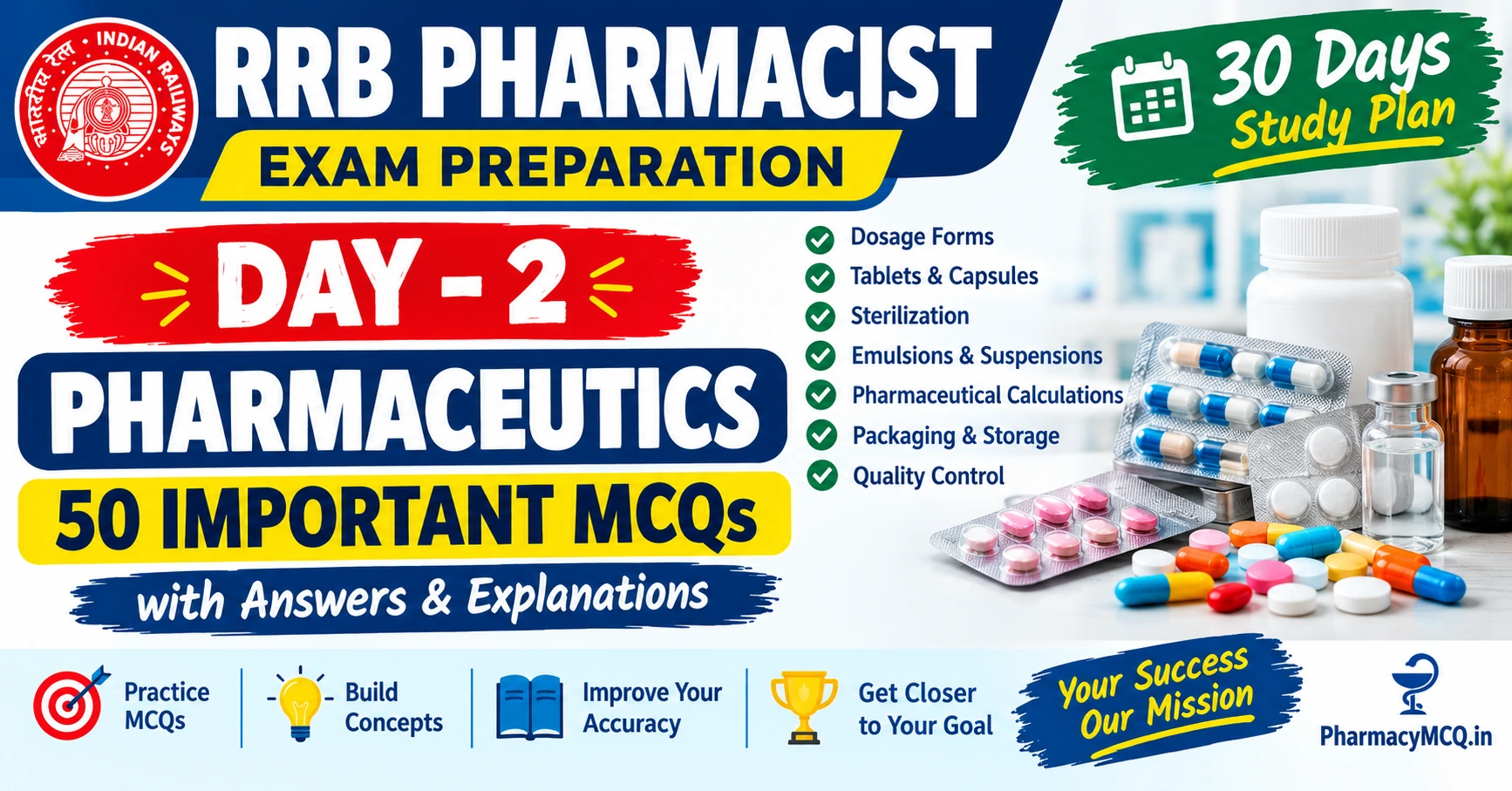
Prepare for the RRB Pharmacist Exam with Day 2 of our 30-day study plan!
Welcome to Day 2 of the RRB Pharmacist Exam Preparation Series on PharmacyMCQ.in. Today, we will practise 50 important multiple-choice questions (MCQs) from Pharmaceutics, a core subject for pharmacy competitive examinations.
These questions cover dosage forms, tablets, capsules, sterilization, emulsions, suspensions, pharmaceutical calculations, packaging, and other essential topics.
Day 2 Study Plan
- Subject: Pharmaceutics
- Total Questions: 50
- Suggested Time: 40–45 minutes
- Difficulty: Basic to moderate
- Goal: Revise key concepts and improve accuracy.
Try answering each question before checking the correct answer and explanation.
Section 1: Basic Pharmaceutics
1. Which of the following is an example of a solid dosage form?
A. Syrup
B. Tablet
C. Elixir
D. Injection
Correct Answer: B. Tablet
Explanation: Tablets are solid dosage forms containing medicinal substances and suitable excipients. They are commonly administered orally.
2. Which dosage form is generally intended for application to the skin?
A. Ointment
B. Elixir
C. Syrup
D. Injection
Correct Answer: A. Ointment
Explanation: Ointments are semisolid preparations intended primarily for application to the skin or certain mucous membranes.
3. Which of the following is a liquid oral dosage form?
A. Capsule
B. Powder
C. Syrup
D. Suppository
Correct Answer: C. Syrup
Explanation: Syrups are concentrated aqueous preparations containing sugar or suitable sugar substitutes, with or without medicinal substances.
4. Which dosage form is designed to melt, soften, or dissolve after insertion into the rectum?
A. Tablet
B. Suppository
C. Capsule
D. Lozenge
Correct Answer: B. Suppository
Explanation: Suppositories are solid dosage forms intended for insertion into body cavities, commonly the rectum, where they melt, soften, or dissolve.
5. Which of the following is a semisolid dosage form?
A. Ointment
B. Tablet
C. Syrup
D. Injection
Correct Answer: A. Ointment
Explanation: Ointments, creams, and gels are common semisolid preparations used for topical application.
6. Which dosage form is intended to dissolve slowly in the mouth?
A. Lozenge
B. Enema
C. Injection
D. Eye drop
Correct Answer: A. Lozenge
Explanation: Lozenges dissolve or disintegrate slowly in the mouth to provide local effects, particularly in the mouth and throat.
7. Which dosage form contains medicinal substances enclosed within a shell?
A. Capsule
B. Syrup
C. Ointment
D. Liniment
Correct Answer: A. Capsule
Explanation: Capsules contain medicinal substances enclosed in a shell, commonly made of gelatin or other suitable materials.
8. Which of the following is a biphasic liquid dosage form?
A. True solution
B. Suspension
C. Syrup
D. Elixir
Correct Answer: B. Suspension
Explanation: A suspension contains insoluble solid particles dispersed in a liquid medium. It is a heterogeneous, biphasic system.
9. Which dosage form is generally prepared by dissolving a drug in a suitable solvent?
A. Solution
B. Suspension
C. Tablet
D. Powder
Correct Answer: A. Solution
Explanation: In a solution, the dissolved substance is distributed at the molecular or ionic level throughout the solvent.
10. Which of the following is commonly used to administer a medicine into the eye?
A. Eye drops
B. Oral suspension
C. Liniment
D. Gargle
Correct Answer: A. Eye drops
Explanation: Ophthalmic preparations, including eye drops, must meet appropriate requirements for quality, sterility, and safety.
Section 2: Tablets and Capsules
11. Which machine is commonly used for large-scale tablet compression?
A. Tablet compression machine
B. Autoclave
C. Centrifuge
D. Distillation apparatus
Correct Answer: A. Tablet compression machine
Explanation: Tablet compression machines compress granules or suitable powders into tablets using punches and dies.
12. Which excipient helps bind powder particles together during tablet granulation?
A. Binder
B. Colouring agent only
C. Preservative only
D. Flavouring agent only
Correct Answer: A. Binder
Explanation: Binders improve the cohesion of powder particles and help produce granules or tablets with suitable mechanical strength.
13. Which excipient helps a tablet break apart after administration?
A. Disintegrant
B. Binder
C. Lubricant
D. Colouring agent
Correct Answer: A. Disintegrant
Explanation: Disintegrants promote tablet breakup into smaller particles when the tablet comes into contact with an appropriate fluid.
14. Which substance is commonly used as a tablet lubricant?
A. Magnesium stearate
B. Sucrose
C. Sodium chloride
D. Starch paste only
Correct Answer: A. Magnesium stearate
Explanation: Magnesium stearate is a commonly used lubricant that reduces friction between the tablet formulation and manufacturing equipment.
15. What is the main purpose of tablet coating?
A. To increase tablet weight only
B. To improve protection, appearance, or drug release characteristics
C. To eliminate the active ingredient
D. To make every tablet dissolve immediately
Correct Answer: B. To improve protection, appearance, or drug release characteristics
Explanation: Coating may improve appearance, mask unpleasant taste, protect the drug, or modify drug release, depending on the coating system.
16. Which type of tablet is designed to resist disintegration in the stomach and release its contents in the intestine?
A. Chewable tablet
B. Enteric-coated tablet
C. Sublingual tablet
D. Buccal tablet
Correct Answer: B. Enteric-coated tablet
Explanation: Enteric coatings resist gastric conditions and are designed to permit release at a higher intestinal pH.
17. Which type of capsule usually consists of two rigid parts?
A. Hard gelatin capsule
B. Soft gelatin capsule
C. Effervescent tablet
D. Buccal tablet
Correct Answer: A. Hard gelatin capsule
Explanation: Conventional hard capsules generally consist of a body and a cap. They are commonly used for powders, granules, and suitable other fills.
18. Which dosage form is often used for filling oils and other suitable liquid formulations?
A. Soft gelatin capsule
B. Dry powder only
C. Chewable tablet
D. Lozenge
Correct Answer: A. Soft gelatin capsule
Explanation: Soft gelatin capsules can accommodate suitable oils and liquids, subject to compatibility and formulation requirements.
19. What is the purpose of a disintegration test for tablets?
A. To measure tablet colour
B. To determine whether tablets break down under specified test conditions
C. To measure only tablet weight
D. To determine the drug’s chemical name
Correct Answer: B. To determine whether tablets break down under specified test conditions
Explanation: The disintegration test evaluates how a dosage unit breaks apart under specified conditions. Disintegration does not necessarily mean that the drug has completely dissolved.
20. Which test evaluates the amount of active ingredient released from a dosage form into a test medium over time?
A. Dissolution test
B. Colour test
C. Hardness test only
D. Friability test
Correct Answer: A. Dissolution test
Explanation: Dissolution testing measures drug release into a specified medium under defined conditions and is important for assessing dosage-form performance.
Section 3: Sterilization and Microbiology
21. Which method uses saturated steam under pressure for sterilization?
A. Autoclaving
B. Filtration only
C. Sedimentation
D. Decantation
Correct Answer: A. Autoclaving
Explanation: Autoclaving uses moist heat, typically saturated steam under pressure, to achieve sterilization. The cycle must be validated for the load and intended use.
22. Which of the following is a common moist-heat sterilization temperature used in an autoclave cycle?
A. 60°C
B. 80°C
C. 121°C
D. 40°C
Correct Answer: C. 121°C
Explanation: A commonly used reference condition is approximately 121°C with an appropriate exposure time. Actual cycle parameters depend on the load, equipment, and validated process.
23. Which method is suitable for sterilizing some heat-sensitive liquid preparations?
A. Membrane filtration
B. Dry-heat sterilization
C. Direct flaming of the final product
D. Boiling in every case
Correct Answer: A. Membrane filtration
Explanation: Suitable membrane filtration can remove microorganisms from heat-sensitive liquids. The process must be appropriately validated, and filtration does not automatically remove every type of contaminant.
24. Which method is commonly used to sterilize heat-stable glassware?
A. Dry heat
B. Simple washing only
C. Sedimentation
D. Refrigeration
Correct Answer: A. Dry heat
Explanation: Validated dry-heat processes can sterilize suitable glassware and other heat-stable materials.
25. What is the primary purpose of sterilization?
A. To improve flavour
B. To eliminate viable microorganisms, including resistant forms when the process is effective
C. To increase sweetness
D. To change the colour of a preparation
Correct Answer: B. To eliminate viable microorganisms, including resistant forms when the process is effective
Explanation: Sterilization is a validated process intended to eliminate viable microorganisms. It differs from disinfection, which may not destroy all microbial forms.
26. Which of the following is a chemical sterilizing agent used for suitable heat-sensitive medical devices?
A. Ethylene oxide
B. Sucrose
C. Sodium bicarbonate
D. Starch
Correct Answer: A. Ethylene oxide
Explanation: Ethylene oxide is used to sterilize certain heat- and moisture-sensitive medical devices. Its use requires strict controls because the gas is hazardous.
27. Which type of filtration is commonly used to remove bacteria from suitable heat-sensitive solutions?
A. Membrane filtration
B. Sand filtration only
C. Gravity separation
D. Paper chromatography
Correct Answer: A. Membrane filtration
Explanation: Appropriately selected and validated membrane filters can remove bacteria from suitable solutions. Filter suitability depends on the product and process.
28. Which instrument is commonly used to monitor pressure in an autoclave?
A. Pressure gauge
B. Thermometer only
C. pH meter
D. Hydrometer
Correct Answer: A. Pressure gauge
Explanation: A pressure gauge measures chamber pressure. Reliable sterilization monitoring also requires appropriate time and temperature monitoring and suitable process controls.
29. Which microorganism is commonly used as a biological indicator for steam sterilization?
A. Geobacillus stearothermophilus
B. Escherichia coli only
C. Saccharomyces cerevisiae only
D. Lactobacillus acidophilus only
Correct Answer: A. Geobacillus stearothermophilus
Explanation: Spores of Geobacillus stearothermophilus are commonly used as biological indicators for steam sterilization because of their resistance to moist heat.
30. Which of the following is the best description of aseptic processing?
A. Processing designed to prevent microbial contamination
B. Adding colour to a medicine
C. Increasing the sweetness of a syrup
D. Reducing tablet size
Correct Answer: A. Processing designed to prevent microbial contamination
Explanation: Aseptic processing involves controlled procedures and environments intended to prevent contamination when sterile components are assembled or handled.
Section 4: Emulsions, Suspensions, and Pharmaceutical Preparations
31. An emulsion is a dispersion of:
A. One liquid in another immiscible liquid
B. A gas in a solid only
C. A solid dissolved completely in a liquid
D. Two gases mixed together
Correct Answer: A. One liquid in another immiscible liquid
Explanation: An emulsion contains droplets of one liquid dispersed in another liquid with which it is immiscible, usually with the aid of an emulsifying agent.
32. Which of the following is commonly used as an emulsifying agent?
A. Acacia
B. Sodium chloride only
C. Talc only
D. Activated charcoal only
Correct Answer: A. Acacia
Explanation: Acacia is a natural gum that can act as an emulsifying agent in suitable formulations.
33. What is the dispersed phase in an oil-in-water emulsion?
A. Oil droplets
B. Water droplets
C. Air bubbles only
D. Solid crystals only
Correct Answer: A. Oil droplets
Explanation: In an oil-in-water emulsion, oil forms the dispersed droplets, while water is the continuous phase.
34. Which preparation contains insoluble solid particles dispersed in a liquid?
A. Suspension
B. True solution
C. Elixir
D. Tincture in every case
Correct Answer: A. Suspension
Explanation: Suspensions contain solid particles dispersed in a liquid medium. They may require shaking before administration, as directed on the label.
35. Which ingredient may be added to a suspension to increase the viscosity of its vehicle?
A. Suspending agent
B. Tablet lubricant
C. Tablet coating pigment only
D. Capsule shell
Correct Answer: A. Suspending agent
Explanation: Suspending agents increase the viscosity of the vehicle or otherwise help maintain acceptable dispersion and reduce rapid settling.
36. What is the main purpose of a preservative in a suitable multidose liquid formulation?
A. To help control microbial growth
B. To make the product sterile automatically
C. To increase drug potency
D. To replace the active ingredient
Correct Answer: A. To help control microbial growth
Explanation: Preservatives help control microbial growth in suitable formulations. They do not replace good manufacturing practices or sterilization when sterility is required.
37. Which preparation is commonly used to clean or treat the oral cavity or throat by rinsing?
A. Gargle
B. Injection
C. Suppository
D. Transdermal patch
Correct Answer: A. Gargle
Explanation: Gargles are liquid preparations used to rinse the throat or oral region, usually without swallowing unless the product directions specifically state otherwise.
38. Which of the following is an example of a transdermal dosage form?
A. Transdermal patch
B. Oral syrup
C. Eye ointment
D. Gargle
Correct Answer: A. Transdermal patch
Explanation: Transdermal patches deliver a drug through the skin into the systemic circulation over a defined period.
39. What is the main purpose of a humectant in a suitable topical formulation?
A. To help retain moisture
B. To sterilize the preparation
C. To compress tablets
D. To measure drug potency
Correct Answer: A. To help retain moisture
Explanation: Humectants attract or retain water and may help maintain moisture in topical preparations.
40. Which dosage form is intended to be administered through the rectum as a liquid?
A. Enema
B. Lozenge
C. Hard capsule
D. Transdermal patch
Correct Answer: A. Enema
Explanation: Enemas are liquid preparations introduced into the rectum for purposes such as bowel evacuation or, in certain formulations, local or systemic drug delivery.
Section 5: Packaging, Pharmaceutical Calculations, and Quality Control
41. Which type of container is commonly used for many pharmaceutical liquids?
A. Bottle
B. Paper envelope in every case
C. Open tray
D. Uncovered bowl
Correct Answer: A. Bottle
Explanation: Pharmaceutical liquids are commonly packaged in suitable bottles selected according to the formulation’s compatibility, protection, and storage requirements.
42. What does the term “expiry date” indicate?
A. The date until which the product is expected to meet its specifications when stored as directed
B. The date the medicine was first discovered
C. The date the medicine was advertised
D. The date the package was designed
Correct Answer: A. The date until which the product is expected to meet its specifications when stored as directed
Explanation: The expiry date is established from stability data and applies when the medicine is stored under the specified conditions.
43. Which test evaluates the tendency of tablets to lose mass through abrasion or handling?
A. Friability test
B. Dissolution test only
C. pH test only
D. Sterility test only
Correct Answer: A. Friability test
Explanation: The friability test assesses a tablet’s resistance to abrasion and mechanical stress under specified test conditions.
44. Which instrument is commonly used to measure the pH of a solution?
A. pH meter
B. Friabilator
C. Tablet hardness tester
D. Dissolution basket only
Correct Answer: A. pH meter
Explanation: A pH meter measures the acidity or alkalinity of a solution.
45. How many milligrams are present in 1 gram?
A. 10 mg
B. 100 mg
C. 1,000 mg
D. 10,000 mg
Correct Answer: C. 1,000 mg
Explanation: One gram equals 1,000 milligrams. Accurate unit conversion is essential in pharmaceutical calculations.
46. A prescription requires 500 mg of a medicine. Each tablet contains 250 mg. How many tablets provide the prescribed amount?
A. 1 tablet
B. 2 tablets
C. 3 tablets
D. 4 tablets
Correct Answer: B. 2 tablets
Explanation: Number of tablets = Required dose ÷ Strength per tablet = 500 mg ÷ 250 mg = 2 tablets. This is a calculation exercise; actual medicine administration must follow a valid prescription and product directions.
47. A liquid contains 100 mg of drug in 5 mL. How much drug is present in 10 mL?
A. 50 mg
B. 100 mg
C. 200 mg
D. 500 mg
Correct Answer: C. 200 mg
Explanation: If the concentration is uniform, doubling the volume from 5 mL to 10 mL doubles the drug amount: 100 mg × 2 = 200 mg.
48. What does “BID” traditionally mean in prescription terminology?
A. Twice daily
B. Once weekly
C. Three times daily
D. At bedtime only
Correct Answer: A. Twice daily
Explanation: BID is a traditional abbreviation meaning twice daily. In actual prescribing and dispensing, clear instructions are preferred to reduce medication errors.
49. Which quality-control test assesses whether a tablet contains the required amount of active ingredient?
A. Assay
B. Colour inspection only
C. Friability test only
D. Packaging inspection only
Correct Answer: A. Assay
Explanation: An assay quantitatively determines the amount of a specified substance, such as the active pharmaceutical ingredient, in a sample.
50. What is the primary purpose of Good Manufacturing Practices (GMP)?
A. To help ensure medicines are consistently produced and controlled to appropriate quality standards
B. To increase the colour of tablets
C. To remove the need for quality control
D. To guarantee that all medicines have the same dose
Correct Answer: A. To help ensure medicines are consistently produced and controlled to appropriate quality standards
Explanation: GMP provides requirements and principles intended to support consistent product quality, safety, and compliance during pharmaceutical manufacturing.
Day 2 Quick Revision: Important Pharmaceutics Facts
| Topic | Key Fact |
|---|---|
| Tablet lubricant | Magnesium stearate |
| Common natural emulsifying agent | Acacia |
| Tablet disintegrant | Helps the tablet break apart |
| Tablet dissolution test | Measures drug release into a medium |
| Tablet friability test | Evaluates resistance to abrasion |
| Autoclaving | Moist-heat sterilization |
| Dry heat | Suitable for certain heat-stable materials |
| Heat-sensitive liquid | May be processed by suitable membrane filtration |
| Oil-in-water emulsion | Oil is the dispersed phase |
| Suspension | Solid particles dispersed in a liquid |
| Hard capsule | Usually has a body and cap |
| Enteric coating | Designed to resist gastric conditions |
| 1 gram | 1,000 milligrams |
| GMP | Supports consistent pharmaceutical quality |
Before starting Day 3, revise these topics:
- Tablet excipients and their functions.
- Tablet manufacturing and quality-control tests.
- Sterilization methods and biological indicators.
- Emulsions, suspensions, and solutions.
- Pharmaceutical calculations and unit conversions.
Write down the questions you answered incorrectly and review their explanations. Understanding why an answer is correct is more useful than memorising the answer alone.
Study with PharmacyMCQ.in: Practise consistently, revise important concepts, and track your progress.
Disclaimer: This article is for educational and competitive-exam practice. Check the official recruitment notification and syllabus for the examination you are preparing for.