
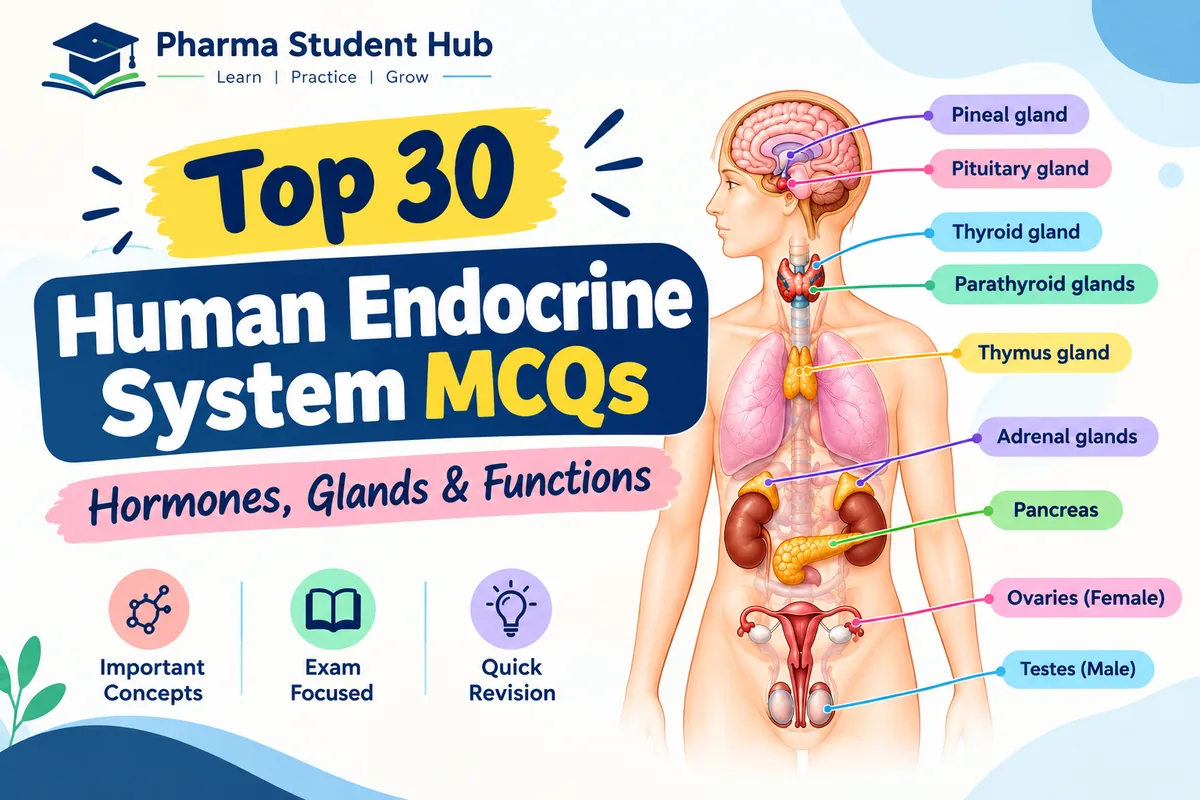
The human endocrine system consists of specialized glands that produce hormones and release them into the bloodstream. These hormones regulate important functions such as growth, metabolism, blood glucose, reproduction, stress response, calcium balance, and water balance.
This MCQ practice set covers the major endocrine glands, important hormones, and their functions. It is useful for pharmacy students, GPAT, RRB Pharmacist, Drug Inspector, and other competitive examinations.
📝Human Endocrine System MCQs
1. Which of the following is commonly called the master gland of the endocrine system?
A. Thyroid gland
B. Pituitary gland
C. Adrenal gland
D. Pineal gland
Answer: B. Pituitary gland
Explanation: The pituitary gland is commonly called the master gland because its hormones regulate several other endocrine glands.
2. Which hormone is secreted by the anterior pituitary gland?
A. Insulin
B. Thyroxine
C. Growth hormone
D. Adrenaline
Answer: C. Growth hormone
Explanation: Growth hormone (GH) is produced by the anterior pituitary and promotes growth of bones and other tissues.
3. Which hormone stimulates the thyroid gland?
A. ACTH
B. TSH
C. FSH
D. ADH
Answer: B. TSH
Explanation: Thyroid-stimulating hormone (TSH) stimulates the thyroid gland to produce thyroid hormones.
4. Which hormone is secreted by the thyroid gland?
A. Insulin
B. Thyroxine
C. Cortisol
D. Glucagon
Answer: B. Thyroxine
Explanation: The thyroid gland produces T4 (thyroxine) and T3 (triiodothyronine), which regulate metabolism and other physiological processes.
5. Which element is essential for the synthesis of thyroid hormones?
A. Iron
B. Calcium
C. Iodine
D. Sodium
Answer: C. Iodine
Explanation: Iodine is an essential component required for the synthesis of T3 and T4.
6. Which hormone primarily increases blood calcium levels?
A. Calcitonin
B. Parathyroid hormone
C. Insulin
D. Melatonin
Answer: B. Parathyroid hormone
Explanation: Parathyroid hormone (PTH) increases blood calcium levels and helps maintain calcium balance.
7. Which cells of the thyroid gland secrete calcitonin?
A. Follicular cells
B. Parafollicular (C) cells
C. Alpha cells
D. Beta cells
Answer: B. Parafollicular (C) cells
Explanation: Parafollicular or C cells of the thyroid gland produce calcitonin, which helps lower blood calcium levels.
8. Which hormone decreases blood glucose levels?
A. Glucagon
B. Insulin
C. Cortisol
D. Adrenaline
Answer: B. Insulin
Explanation: Insulin is secreted by pancreatic beta cells and lowers blood glucose by promoting glucose uptake and storage.
9. Insulin is secreted by which cells of the pancreas?
A. Alpha cells
B. Beta cells
C. Delta cells
D. Acinar cells
Answer: B. Beta cells
Explanation: Beta cells of the islets of Langerhans produce insulin.
10. Which hormone increases blood glucose levels?
A. Insulin
B. Glucagon
C. Somatostatin
D. Calcitonin
Answer: B. Glucagon
Explanation: Glucagon is produced by pancreatic alpha cells and increases blood glucose, especially during fasting.
11. Glucagon is secreted by:
A. Alpha cells
B. Beta cells
C. Delta cells
D. Chief cells
Answer: A. Alpha cells
Explanation: Alpha cells of the pancreatic islets secrete glucagon.
12. Which gland is located on top of each kidney?
A. Thyroid gland
B. Adrenal gland
C. Pituitary gland
D. Pineal gland
Answer: B. Adrenal gland
Explanation: The adrenal glands are located above the kidneys and consist of an outer cortex and inner medulla.
13. Which hormone is secreted by the adrenal medulla?
A. Cortisol
B. Aldosterone
C. Adrenaline
D. Thyroxine
Answer: C. Adrenaline
Explanation: The adrenal medulla produces adrenaline (epinephrine) and noradrenaline, which are involved in the fight-or-flight response.
14. Which hormone is produced by the adrenal cortex?
A. Cortisol
B. Insulin
C. Melatonin
D. Growth hormone
Answer: A. Cortisol
Explanation: Cortisol is a glucocorticoid produced by the adrenal cortex and plays an important role in the stress response and metabolism.
15. Aldosterone mainly regulates:
A. Blood glucose
B. Sodium and potassium balance
C. Body temperature
D. Growth
Answer: B. Sodium and potassium balance
Explanation: Aldosterone promotes sodium reabsorption and potassium secretion by the kidneys.
16. Which gland secretes melatonin?
A. Pineal gland
B. Thyroid gland
C. Pituitary gland
D. Thymus
Answer: A. Pineal gland
Explanation: The pineal gland produces melatonin, which helps regulate the sleep-wake cycle.
17. ADH is also known as:
A. Oxytocin
B. Vasopressin
C. Thyroxine
D. Cortisol
Answer: B. Vasopressin
Explanation: Antidiuretic hormone (ADH) is also called vasopressin and helps maintain water balance.
18. ADH mainly promotes:
A. Calcium absorption
B. Water reabsorption
C. Glucose breakdown
D. Thyroid hormone secretion
Answer: B. Water reabsorption
Explanation: ADH increases water reabsorption in the kidneys, helping maintain body fluid balance.
19. Which hormone stimulates milk production?
A. Oxytocin
B. Prolactin
C. Estrogen
D. Progesterone
Answer: B. Prolactin
Explanation: Prolactin is secreted by the anterior pituitary and stimulates milk production.
20. Which hormone is mainly responsible for milk ejection?
A. Prolactin
B. Oxytocin
C. FSH
D. LH
Answer: B. Oxytocin
Explanation: Oxytocin causes contraction of myoepithelial cells in the mammary glands, resulting in milk ejection.
21. Which hormone triggers ovulation?
A. FSH
B. LH
C. Prolactin
D. ADH
Answer: B. LH
Explanation: A surge in luteinizing hormone (LH) triggers ovulation.
22. Which hormone stimulates testosterone production in males?
A. FSH
B. LH
C. TSH
D. ACTH
Answer: B. LH
Explanation: LH stimulates Leydig cells of the testes to produce testosterone.
23. Which hormone supports spermatogenesis?
A. FSH
B. TSH
C. ACTH
D. ADH
Answer: A. FSH
Explanation: FSH acts on Sertoli cells and supports the process of sperm production.
24. Which gland has both endocrine and exocrine functions?
A. Thyroid
B. Pancreas
C. Pituitary
D. Pineal
Answer: B. Pancreas
Explanation: The pancreas has an endocrine function through the islets of Langerhans and an exocrine function through its digestive enzyme-producing cells.
25. Which structure contains the endocrine cells of the pancreas?
A. Nephrons
B. Islets of Langerhans
C. Thyroid follicles
D. Alveoli
Answer: B. Islets of Langerhans
Explanation: The islets of Langerhans contain pancreatic endocrine cells that produce hormones such as insulin, glucagon, and somatostatin.
26. Which hormone helps decrease blood calcium levels?
A. Parathyroid hormone
B. Calcitonin
C. Cortisol
D. Aldosterone
Answer: B. Calcitonin
Explanation: Calcitonin helps lower blood calcium levels, particularly by reducing bone resorption.
27. Which hormone is primarily responsible for regulating metabolic rate?
A. Thyroxine
B. Insulin
C. Oxytocin
D. ADH
Answer: A. Thyroxine
Explanation: Thyroid hormones, especially T3 and T4, have major effects on metabolic activity.
28. Which hormone is associated with the body’s response to stress?
A. Cortisol
B. Calcitonin
C. Insulin
D. Melatonin
Answer: A. Cortisol
Explanation: Cortisol helps the body respond to stress and influences metabolism and immune activity.
29. Which hormone is secreted by pancreatic delta cells?
A. Insulin
B. Glucagon
C. Somatostatin
D. Adrenaline
Answer: C. Somatostatin
Explanation: Delta cells of the pancreatic islets secrete somatostatin, which has inhibitory effects on several hormones.
30. Which of the following pairs is correctly matched?
A. Pineal gland — Melatonin
B. Thyroid gland — Insulin
C. Pancreas — Thyroxine
D. Adrenal medulla — Growth hormone
Answer: A. Pineal gland — Melatonin
Explanation: The pineal gland secretes melatonin, which helps regulate circadian rhythms and the sleep-wake cycle.
📑Quick Revision: Important Hormone Functions
- Insulin → Decreases blood glucose
- Glucagon → Increases blood glucose
- PTH → Increases blood calcium
- Calcitonin → Helps decrease blood calcium
- ADH → Promotes water reabsorption
- Aldosterone → Promotes sodium retention and potassium secretion
- Cortisol → Stress response and metabolic regulation
- Thyroxine (T3/T4) → Regulates metabolism
- Melatonin → Regulates sleep-wake cycle
- Prolactin → Milk production
- Oxytocin → Milk ejection and uterine contractions
- LH → Ovulation and testosterone production
- FSH → Follicular development and supports spermatogenesis
🎯Conclusion
The endocrine system plays a vital role in maintaining the body’s internal balance through the coordinated action of hormones. Understanding the major endocrine glands, their hormones, and their functions is important for students preparing for pharmacy and other competitive examinations.
The most important areas to revise include the pituitary gland, thyroid gland, parathyroid glands, pancreas, adrenal glands, pineal gland, and reproductive glands, along with key hormone-function relationships such as insulin and glucose regulation, PTH and calcium regulation, ADH and water balance, and thyroid hormones and metabolism.
Regular practice of MCQs can help improve recall and prepare you for hormone-related questions commonly encountered in anatomy, physiology, pharmacology, and competitive pharmacy examinations.