📌 Introduction
Drug–receptor interactions are one of the most important concepts in pharmacology. Many medicines produce their effects by interacting with specific receptors present on cells or tissues. Understanding how drugs bind to receptors helps us understand why a drug produces a particular effect, why different drugs have different strengths, and how agonists and antagonists work.
For pharmacy students and competitive examinations, drug–receptor interactions are an important topic because questions are commonly asked about affinity, efficacy, potency, agonists, antagonists, partial agonists, inverse agonists, and different types of receptor interactions.
🔍What Is a Drug Receptor?
A receptor is usually a protein molecule located on the surface of a cell or inside the cell. It recognizes specific chemical substances, including drugs and naturally occurring substances such as hormones and neurotransmitters.
When a drug interacts with its receptor, it may produce a biological response. The interaction between a drug and receptor is often compared to a key fitting into a lock. However, this analogy is not completely accurate because receptors can undergo structural changes when drugs bind to them.
The ability of a drug to bind to a receptor is called affinity. A drug with high affinity can bind strongly to its receptor.
🟢Affinity, Efficacy and Potency
Three important terms should be understood when studying drug–receptor interactions.
1. Affinity
Affinity refers to the ability of a drug to bind to a receptor.
A drug with high affinity generally binds more readily to its receptor than a drug with low affinity.
2. Efficacy
Efficacy refers to the ability of a drug, after binding to a receptor, to produce a biological response.
For example, an agonist has both affinity and efficacy, while a competitive antagonist generally has affinity but no intrinsic efficacy.
3. Potency
Potency refers to the amount of drug required to produce a particular effect.
A highly potent drug can produce a specific effect at a lower dose compared with a less potent drug.
Therefore, affinity, efficacy, and potency are different concepts and should not be confused.
📝Types of Drug–Receptor Interactions
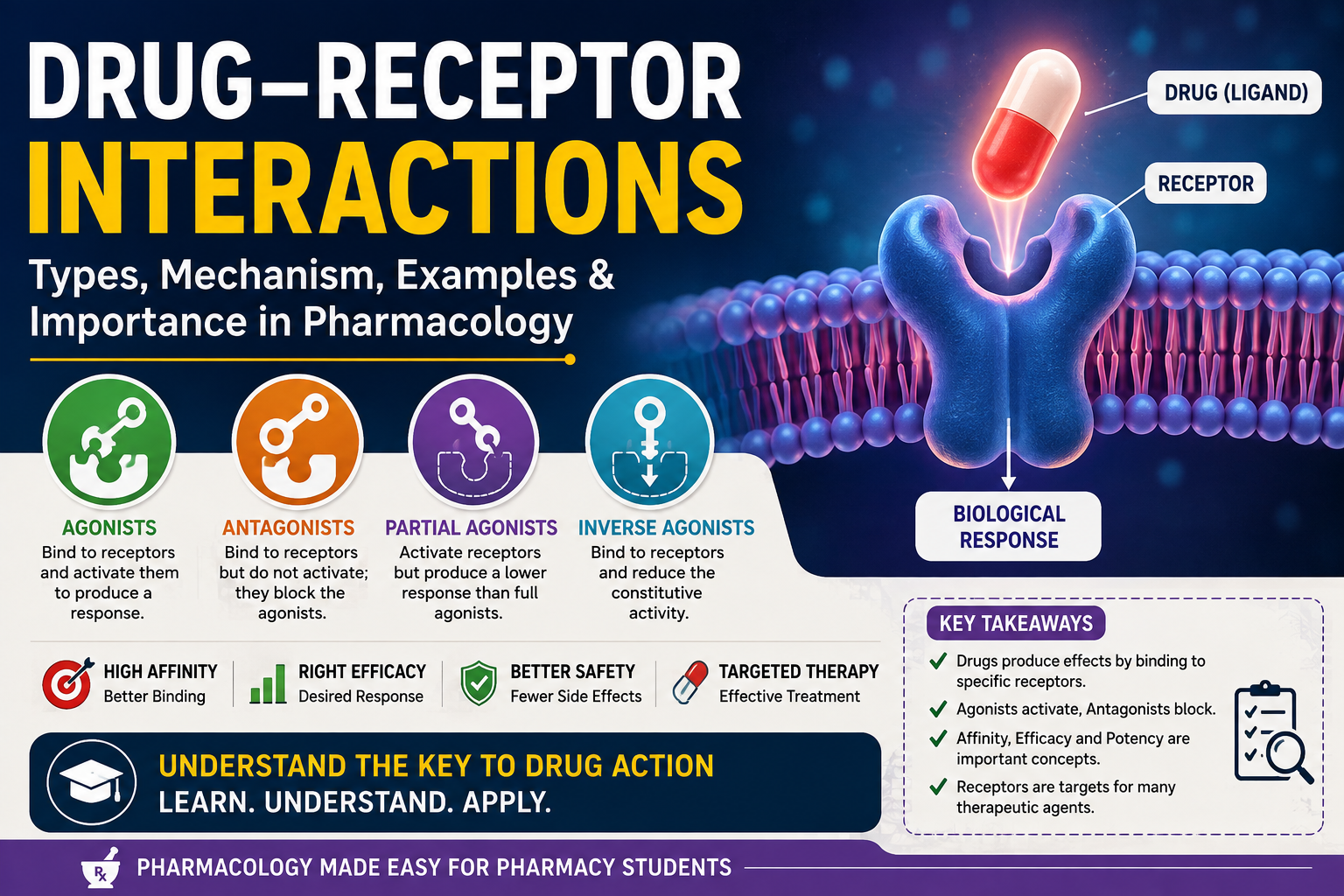
Drug–receptor interactions can be classified according to the type of response produced by the drug.
The major types include:
- Agonists
- Antagonists
- Partial agonists
- Inverse agonists
1. Agonists
An agonist is a drug that binds to a receptor and activates it to produce a biological response.
An agonist generally possesses both affinity and efficacy.
For example, salbutamol acts as a β2-adrenergic receptor agonist and produces bronchodilation. This makes it useful in conditions involving bronchoconstriction.
Other examples of agonists include morphine at opioid receptors and adrenaline at adrenergic receptors.
Full Agonist
A full agonist can produce the maximum possible response of the receptor system when sufficient receptors are occupied.
The maximum effect produced by a full agonist is called its maximal efficacy.
2. Antagonists
An antagonist is a drug that binds to a receptor but does not activate it to produce the usual receptor response.
Instead, it blocks or reduces the action of an agonist.
An antagonist generally has affinity but no intrinsic efficacy.
For example, atropine blocks muscarinic acetylcholine receptors and prevents the actions of acetylcholine at those receptors.
Antagonists are extremely important therapeutically because they can prevent unwanted physiological or pathological effects.
Competitive Antagonism
A competitive antagonist competes with an agonist for the same receptor site.
Because both drugs compete for the same site, increasing the concentration of the agonist may overcome the effect of a reversible competitive antagonist.
For example, naloxone is an opioid receptor antagonist and can block opioid effects.
Non-Competitive Antagonism
A non-competitive antagonist reduces the response produced by an agonist in a way that cannot be fully overcome simply by increasing the agonist concentration.
This may occur when the antagonist binds irreversibly to the receptor or interferes with receptor function at another site.
3. Partial Agonists
A partial agonist binds to a receptor and activates it, but produces a lower maximum response than a full agonist, even when it occupies a large proportion of available receptors.
Therefore, a partial agonist has both affinity and efficacy, but its efficacy is lower than that of a full agonist.
A useful example is buprenorphine, which acts as a partial agonist at certain opioid receptors.
An important examination point is that a partial agonist can behave differently depending on the presence of another drug.
When a full agonist is present, a partial agonist may reduce the overall response because it occupies receptors but produces a weaker response.
4. Inverse Agonists
An inverse agonist binds to a receptor and produces an effect opposite to that of an agonist by reducing constitutive receptor activity.
Some receptors can show activity even in the absence of an agonist. This is known as constitutive activity.
An inverse agonist reduces this baseline receptor activity.
This is different from an antagonist because an antagonist generally blocks receptor activation without producing the opposite response.
🧬Reversible and Irreversible Drug Binding
Drug binding to receptors can also be classified according to how strongly and permanently the drug interacts with the receptor.
Reversible Binding
In reversible binding, the drug can detach from the receptor.
Many drug–receptor interactions are reversible and involve weak chemical forces such as hydrogen bonds, ionic interactions, and van der Waals forces.
Because the interaction can be reversed, the drug concentration and receptor occupancy can change over time.
Irreversible Binding
In irreversible binding, the drug forms a very strong, often covalent, interaction with the receptor.
The receptor remains unavailable until new receptors are synthesized or the drug–receptor complex is otherwise removed.
Irreversible interactions can therefore produce prolonged effects.
📍Major Receptor Families
Drug receptors can be divided into several major families according to their structure and mechanism of action.
1. Ligand-Gated Ion Channels
These receptors are directly associated with ion channels.
When a ligand binds to the receptor, the channel opens or closes, allowing ions to move across the cell membrane.
They generally produce very rapid responses.
An example is the nicotinic acetylcholine receptor.
2. G-Protein-Coupled Receptors
G-protein-coupled receptors, or GPCRs, interact with G proteins and activate intracellular signaling pathways.
They can produce effects through second messengers such as cyclic AMP and intracellular calcium.
Examples include adrenergic, muscarinic, dopamine, and many histamine receptors.
3. Enzyme-Linked Receptors
These receptors are associated with enzymes or possess enzymatic activity.
Binding of a drug or natural ligand can activate intracellular signaling pathways.
Insulin receptors are an important example of enzyme-linked receptors.
4. Intracellular Receptors
Some drugs and hormones can cross the cell membrane and interact with receptors located inside the cell.
These receptors often influence gene transcription and therefore usually produce slower but longer-lasting effects.
Steroid hormone receptors are important examples of intracellular receptors.
✒️Why Drug–Receptor Interactions Are Important
Understanding drug–receptor interactions is important for several reasons.
First, it helps explain the mechanism of action of medicines. Second, it helps pharmacists and healthcare professionals understand differences between drugs.
For example, two drugs may act on the same receptor but produce different responses because one may be a full agonist while another is a partial agonist.
Receptor interactions also help explain drug toxicity and adverse effects. A drug may interact with receptors in tissues other than the intended target, producing unwanted effects.
Knowledge of receptor interactions is also important in drug development. Researchers try to develop drugs that act selectively on particular receptors to produce therapeutic effects while minimizing unwanted effects.
💊Important Differences
The following points are useful for examination preparation:
Agonist: Has affinity and efficacy and activates the receptor.
Antagonist: Has affinity but little or no intrinsic efficacy and blocks receptor activation.
Partial agonist: Has affinity and produces a response, but its maximum response is lower than that of a full agonist.
Inverse agonist: Binds to the receptor and reduces constitutive receptor activity.
Affinity: Ability of a drug to bind to a receptor.
Efficacy: Ability of a drug to produce a biological response after receptor interaction.
Potency: Amount of drug required to produce a particular effect.
📋Frequently Asked Questions
What is a receptor?
A receptor is usually a protein that recognizes specific molecules and mediates their biological effects.
What is an agonist?
An agonist is a drug that binds to a receptor and activates it to produce a response.
What is an antagonist?
An antagonist binds to a receptor and prevents or reduces receptor activation by an agonist.
What is the difference between potency and efficacy?
Potency refers to the amount of drug required to produce an effect, whereas efficacy refers to the maximum effect a drug can produce.
What is a partial agonist?
A partial agonist activates a receptor but produces a lower maximum response than a full agonist.
🎯Conclusion
Drug–receptor interactions form the foundation of pharmacology and help explain how medicines produce their therapeutic effects. Agonists activate receptors, antagonists block receptor activation, partial agonists produce limited receptor responses, and inverse agonists reduce constitutive receptor activity.
Understanding affinity, efficacy, and potency is equally important because these concepts explain differences in drug action. Knowledge of receptor families such as ligand-gated ion channels, G-protein-coupled receptors, enzyme-linked receptors, and intracellular receptors provides a deeper understanding of how drugs act inside the body.
For B.Pharm students and pharmacy competitive examinations, drug–receptor interactions are an important topic and should be studied carefully along with examples and mechanisms.