
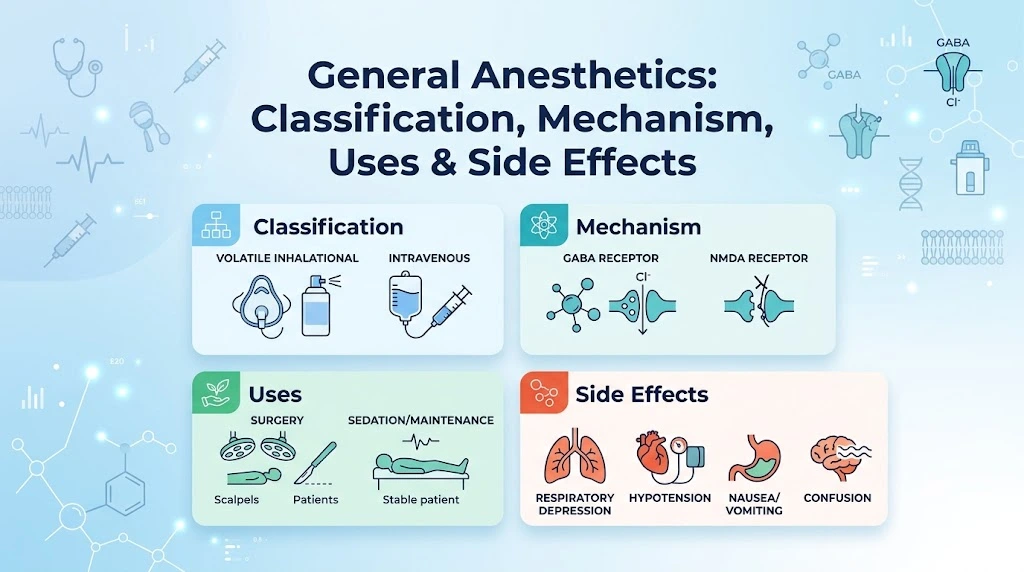
General anesthetics are drugs that produce a reversible loss of consciousness and reduce awareness of the surgical environment. They are used during surgical procedures and selected medical interventions under appropriate monitoring.
For pharmacy students, general anesthetics are an important topic in pharmacology. Understanding their classification, mechanisms of action, pharmacological effects, and adverse effects is useful for GPAT, RRB Pharmacist, DSSSB Pharmacist, B.Pharm, and D.Pharm examinations.
In this article, you will learn about the major classes of general anesthetics, their mechanisms, clinical uses, and important examination points.
🔍What Are General Anesthetics?
General anesthetics are medicines that produce a controlled, reversible state of unconsciousness. Depending on the drug and the combination used, general anesthesia can provide unconsciousness, amnesia, immobility, and suppression of responses to surgical stimulation.
Not every general anesthetic provides adequate pain relief or muscle relaxation on its own. Other medicines, such as opioids or neuromuscular blocking agents, may be used when clinically appropriate.
General anesthetics are administered mainly through two routes:
- Inhalational route
- Intravenous route
📝Classification of General Anesthetics
1. Inhalational Anesthetics
These agents are administered through the respiratory system.
A. Gases
- Nitrous oxide
- Xenon (where available)
B. Volatile liquids
- Sevoflurane
- Isoflurane
- Desflurane
- Halothane
- Enflurane
Ether is an important historical example but is no longer routinely used in many modern settings.
2. Intravenous Anesthetics
These drugs are administered directly into a vein.
A. Barbiturates
- Thiopental sodium
- Methohexital
B. Non-barbiturate hypnotic anesthetics
- Propofol
- Etomidate
C. Dissociative anesthetics
- Ketamine
D. Benzodiazepines
- Midazolam
- Diazepam
Benzodiazepines produce sedation, anxiolysis, and amnesia, but are not generally sufficient as sole agents for surgical general anesthesia.
Important distinction: Opioids such as fentanyl and neuromuscular blockers may be used as components of an anesthetic technique, but they are not interchangeable with general anesthetics. Opioids primarily provide analgesia, while neuromuscular blockers produce paralysis without causing unconsciousness.
⚕️Mechanism of Action of General Anesthetics
General anesthetics act on multiple targets in the central nervous system. Their exact mechanisms differ among drugs, and no single mechanism explains every component of general anesthesia.
1. Enhancement of GABA-A Receptor Activity
Many intravenous anesthetics, including propofol, etomidate, and barbiturates, enhance inhibitory neurotransmission involving GABA-A receptors.
This increases neuronal inhibition and helps produce hypnosis and unconsciousness.
2. Inhibition of NMDA Receptors
Ketamine and nitrous oxide inhibit signalling involving NMDA-type glutamate receptors.
Ketamine produces dissociative anesthesia, characterised by a distinctive state of altered awareness and analgesia.
3. Effects on Ion Channels
Several inhalational anesthetics influence multiple neuronal ion channels, including certain potassium channels and inhibitory receptor systems. These effects alter neuronal excitability and synaptic transmission.
4. Overall Effect
The combined effects of general anesthetics suppress activity in neural networks involved in awareness, memory, and responses to surgical stimulation.
Exam point: Propofol and etomidate enhance GABA-A receptor activity, whereas ketamine is primarily associated with NMDA receptor antagonism.
📍Important General Anesthetic Drugs
1. Propofol
Class: Intravenous hypnotic anesthetic
Mechanism of action: Primarily enhances GABA-A receptor-mediated inhibition.
Uses:
- Induction of general anesthesia
- Maintenance of general anesthesia
- Procedural sedation in appropriate settings
Adverse effects:
- Hypotension
- Respiratory depression
- Pain during injection
- Rare but serious propofol infusion syndrome with prolonged high-dose infusion in susceptible circumstances
Important point: Propofol has a rapid onset and generally rapid recovery after a single induction dose. It does not provide reliable analgesia by itself.
2. Thiopental Sodium
Class: Intravenous barbiturate
Mechanism of action: Enhances GABA-A receptor-mediated inhibition.
Uses:
- Induction of anesthesia in selected circumstances
- Selected specialist applications
Adverse effects:
- Respiratory depression
- Cardiovascular depression
- Prolonged recovery after repeated doses due to redistribution and accumulation
Important point: Thiopental is an ultrashort-acting barbiturate commonly discussed in traditional pharmacology examinations.
3. Ketamine
Class: Dissociative anesthetic
Mechanism of action: Primarily blocks NMDA receptors.
Uses:
- Induction of anesthesia in selected patients
- Procedural sedation and analgesia in appropriate settings
Adverse effects:
- Increased heart rate and blood pressure in many patients
- Increased salivation
- Emergence reactions, including vivid dreams or hallucinations
- Respiratory complications can still occur, particularly in certain circumstances
Important point: Ketamine provides analgesia and dissociative anesthesia and often preserves respiratory drive and airway reflexes better than some other anesthetics. However, it does not eliminate the risk of airway obstruction or respiratory complications.
4. Etomidate
Class: Intravenous hypnotic anesthetic
Mechanism of action: Enhances GABA-A receptor activity.
Uses:
- Induction of general anesthesia, particularly when cardiovascular stability is a concern
Adverse effects:
- Myoclonus
- Nausea and vomiting
- Adrenal suppression, especially following repeated administration or infusion
Important point: Etomidate generally causes less cardiovascular depression than many alternative induction agents, but it has other important limitations.
5. Sevoflurane
Class: Volatile inhalational anesthetic
Mechanism of action: Acts on multiple neuronal targets, including inhibitory receptor systems and ion channels.
Uses:
- Induction of anesthesia by inhalation in suitable patients
- Maintenance of general anesthesia
Adverse effects:
- Dose-dependent respiratory depression
- Hypotension
- Nausea and vomiting after surgery
- Rare malignant hyperthermia in susceptible individuals
Important point: Sevoflurane is widely used because it allows controllable inhalational anesthesia and is suitable for inhalational induction in selected circumstances.
6. Isoflurane
Class: Volatile inhalational anesthetic
Uses:
- Maintenance of general anesthesia
Adverse effects:
- Hypotension due to reduced systemic vascular resistance
- Respiratory depression
- Dose-dependent cardiovascular effects
Important point: Isoflurane is primarily associated with maintenance rather than routine inhalational induction.
7. Desflurane
Class: Volatile inhalational anesthetic
Uses:
- Maintenance of general anesthesia
Adverse effects:
- Respiratory irritation
- Coughing or airway stimulation
- Tachycardia and increased blood pressure with rapid increases in concentration
Important point: Desflurane has low blood–gas solubility, allowing rapid changes in anesthetic depth. Its airway irritation limits its suitability for inhalational induction.
8. Nitrous Oxide
Class: Inhalational anesthetic gas
Mechanism of action: Primarily associated with NMDA receptor antagonism.
Uses:
- Analgesia in selected clinical settings
- As an adjunct to other anesthetic agents
Adverse effects and precautions:
- Nausea and vomiting
- Expansion of gas-filled spaces
- Inactivation of vitamin B12-dependent enzymes with significant exposure
Important point: Nitrous oxide provides useful analgesia but is relatively weak as a sole general anesthetic at ordinary atmospheric pressure.
Pharmacological Effects of General Anesthetics
The effects vary by drug, dose, and the patient’s clinical condition.
1. Central Nervous System
- Reduced awareness and consciousness
- Amnesia
- Reduced response to surgical stimulation
- Changes in neuronal activity
2. Respiratory System
- Reduced ventilation
- Dose-dependent respiratory depression
- Possible airway complications
3. Cardiovascular System
- Hypotension with many agents
- Changes in heart rate
- Drug-specific effects on cardiac function and vascular resistance
4. Other Effects
- Nausea and vomiting
- Changes in muscle tone
- Drug-specific effects on temperature regulation and organ function
Stages of Anesthesia
The traditional four stages of general anesthesia are associated with the historical Guedel classification, developed around ether anesthesia.
- Stage I – Analgesia: Pain perception is reduced, while consciousness may remain present.
- Stage II – Excitement or delirium: A transitional stage that can involve irregular breathing and involuntary movements.
- Stage III – Surgical anesthesia: The historical stage in which anesthesia is sufficiently deep for surgery.
- Stage IV – Medullary paralysis: Excessive anesthetic depth with severe suppression of vital functions.
Important clarification: These stages are mainly of historical and educational importance. Modern anesthesia uses different agents, combinations, monitoring, and techniques, so patients do not necessarily pass through all four stages in the same predictable way.
Minimum Alveolar Concentration (MAC)
Minimum alveolar concentration (MAC) is an important concept in inhalational anesthesia.
It is the alveolar concentration of an inhaled anesthetic at one atmosphere that prevents movement in response to a standard surgical stimulus in 50% of subjects.
Important points:
- MAC is used to compare the potency of inhalational anesthetics.
- A lower MAC generally indicates greater anesthetic potency.
- MAC is influenced by factors such as age and other medicines.
- MAC is not a direct measurement of consciousness or a universal measure of every component of anesthesia.
Important Adverse Effects and Complications
General anesthesia is administered by trained professionals with appropriate monitoring because excessive anesthetic effects can be dangerous.
Important risks include:
- Respiratory depression
- Hypotension and cardiovascular depression
- Postoperative nausea and vomiting
- Delayed recovery
- Aspiration and airway complications
- Rare malignant hyperthermia in susceptible individuals
- Drug-specific complications, such as adrenal suppression with etomidate or propofol infusion syndrome with prolonged high-dose infusion
Malignant hyperthermia is a potentially life-threatening reaction associated with certain volatile anesthetics and the depolarising neuromuscular blocker succinylcholine in susceptible individuals. It requires urgent specialist treatment.
Quick Revision Table
| Drug | Class | Key mechanism or feature |
|---|---|---|
| Propofol | IV anesthetic | Enhances GABA-A activity |
| Thiopental | Barbiturate | Enhances GABA-A activity |
| Etomidate | IV anesthetic | Enhances GABA-A activity |
| Ketamine | Dissociative anesthetic | NMDA receptor antagonist |
| Sevoflurane | Inhalational | Used for induction and maintenance |
| Isoflurane | Inhalational | Mainly used for maintenance |
| Desflurane | Inhalational | Low blood–gas solubility; airway irritation |
| Nitrous oxide | Inhalational gas | Analgesia; NMDA receptor antagonism |
📑Important Exam Points
- Propofol is an intravenous anesthetic that enhances GABA-A receptor activity.
- Ketamine produces dissociative anesthesia and is primarily an NMDA receptor antagonist.
- Etomidate is associated with adrenal suppression.
- Sevoflurane can be used for inhalational induction in suitable patients.
- Desflurane has low blood–gas solubility but can irritate the airways.
- Nitrous oxide provides analgesia but is a relatively weak general anesthetic when used alone.
- MAC is a measure used to compare the potency of inhalational anesthetics.
- Malignant hyperthermia is a serious, rare anesthetic complication.
- Neuromuscular blockers produce paralysis but do not produce unconsciousness.
- General anesthesia requires appropriate airway, respiratory, and cardiovascular monitoring.
📋Frequently Asked Questions
1. What are the two main classes of general anesthetics?
The two main classes are inhalational anesthetics and intravenous anesthetics.
2. Which intravenous anesthetic is associated with NMDA receptor antagonism?
Ketamine is the classic example of an intravenous anesthetic that primarily produces its effects through NMDA receptor antagonism.
3. Which anesthetic is associated with adrenal suppression?
Etomidate is associated with inhibition of adrenal steroid synthesis, particularly through effects on 11β-hydroxylase.
4. What is MAC in anesthesia?
Minimum alveolar concentration is the alveolar concentration of an inhaled anesthetic that prevents movement in response to a standard surgical stimulus in 50% of subjects.
5. Which inhalational anesthetic has low blood–gas solubility and can irritate the airway?
Desflurane has low blood–gas solubility, allowing rapid changes in anesthetic depth, but it can irritate the airway.
6. Are benzodiazepines general anesthetics?
Benzodiazepines produce sedation, anxiolysis, and amnesia. They may be used as part of an anesthetic plan, but they are not generally sufficient as sole agents for surgical general anesthesia.
🎯 Conclusion
General anesthetics are essential medicines used to produce reversible unconsciousness during surgery and selected medical procedures. Their effects depend on the agent, dose, route, and combination of medicines used.
For examination preparation, focus on drug classification, mechanisms of action, characteristic adverse effects, MAC, and the differences between propofol, ketamine, etomidate, sevoflurane, desflurane, and nitrous oxide.
Educational disclaimer: This article is intended for pharmacy education and examination preparation. General anesthetics must be administered by appropriately trained healthcare professionals with suitable monitoring.
1 thought on “General Anesthetics: Classification, Mechanism, Uses & Side Effects”