📌 Introduction
Diuretics are an important group of drugs in pharmacology that increase the excretion of water and electrolytes through the kidneys. They are commonly used in the management of conditions such as hypertension, edema, heart failure, and certain kidney and electrolyte disorders.
Because different diuretics act at different parts of the nephron, understanding their site of action, mechanism, therapeutic uses, and adverse effects is important for pharmacy students.
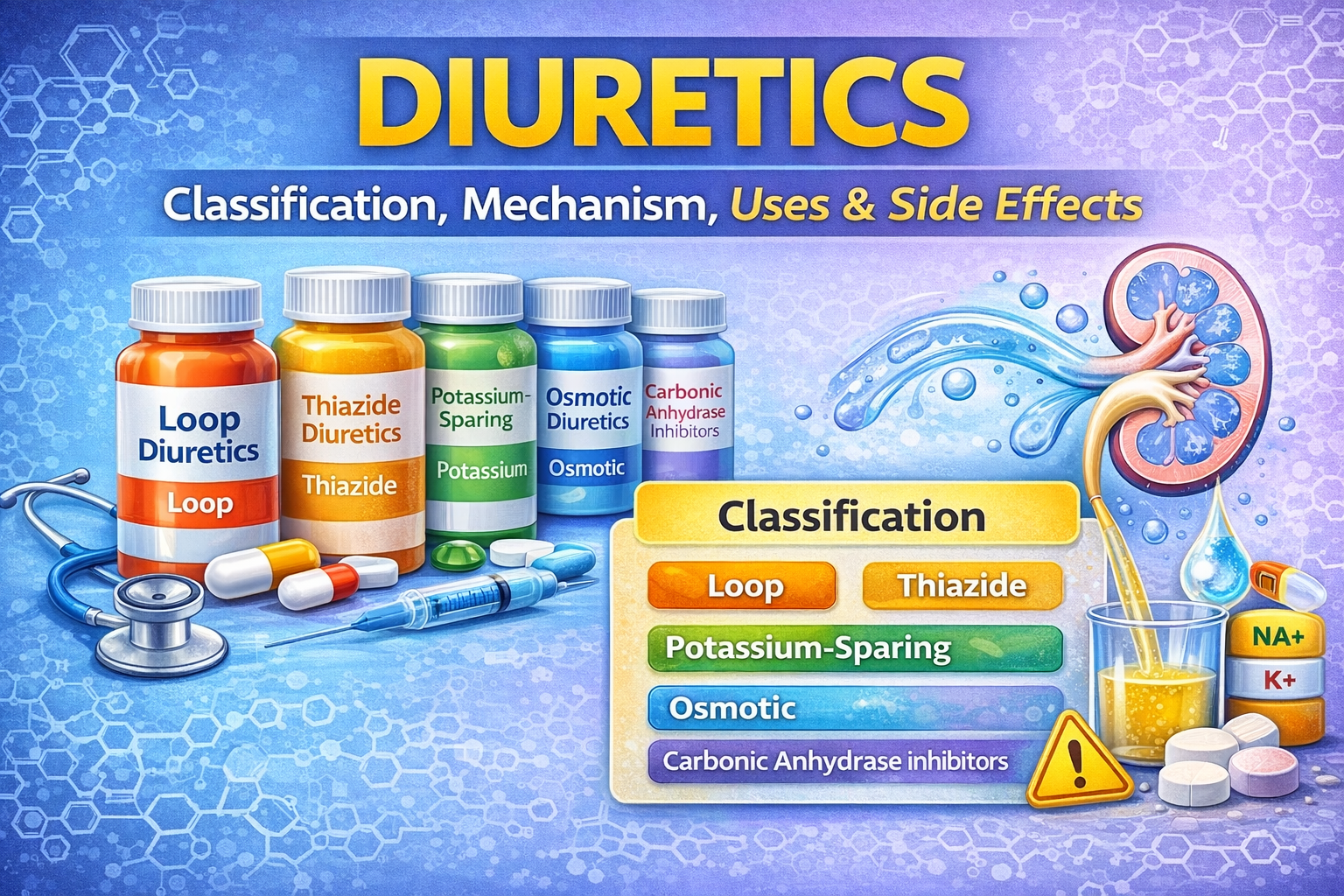
Diuretics are commonly classified into groups such as loop diuretics, thiazide and thiazide-like diuretics, potassium-sparing diuretics, carbonic anhydrase inhibitors, and osmotic diuretics.
This article explains the major classes of diuretics, their mechanisms of action, important examples, therapeutic uses, adverse effects, and key points for pharmacy examinations.
🔍What Are Diuretics?
Diuretics are drugs that increase the formation and excretion of urine by the kidneys.
Most diuretics work by reducing the reabsorption of sodium at specific sites in the renal tubules. Because water follows sodium, increased sodium excretion generally results in increased water excretion.
In simple terms:
Diuretic → Decreased sodium reabsorption → Increased sodium excretion → Increased water excretion → Increased urine output
The extent of sodium and water loss depends on the particular class of diuretic.
📖Why Are Diuretics Important?
Diuretics have several important clinical applications.
They may be used to:
- Reduce edema
- Lower blood pressure
- Reduce fluid overload
- Manage symptoms associated with heart failure
- Treat certain electrolyte disorders
- Reduce increased intraocular pressure in selected situations
- Reduce increased intracranial pressure in selected situations
- Treat some specific renal conditions
Different diuretics have different strengths and mechanisms, so the choice depends on the clinical condition.
📝Classification of Diuretics
The major classes of diuretics include:
- Loop diuretics
- Thiazide and thiazide-like diuretics
- Potassium-sparing diuretics
- Carbonic anhydrase inhibitors
- Osmotic diuretics
A simplified classification is given below.
| Class | Important Examples | Main Site/Target |
|---|---|---|
| Loop diuretics | Furosemide, Bumetanide, Torsemide | Thick ascending limb |
| Thiazide diuretics | Hydrochlorothiazide, Bendroflumethiazide | Distal convoluted tubule |
| Thiazide-like diuretics | Chlorthalidone, Indapamide | Distal nephron |
| Potassium-sparing | Spironolactone, Eplerenone, Amiloride, Triamterene | Late distal tubule/collecting duct |
| Carbonic anhydrase inhibitors | Acetazolamide | Proximal tubule |
| Osmotic diuretics | Mannitol | Mainly proximal tubule and descending limb |
1. Loop Diuretics
Loop diuretics are among the most powerful diuretics.
They act mainly on the thick ascending limb of the loop of Henle.
Important Examples
- Furosemide
- Bumetanide
- Torsemide
- Ethacrynic acid
Furosemide is one of the most commonly recognized loop diuretics in pharmacology.
Mechanism of Action of Loop Diuretics
Loop diuretics inhibit the Na⁺-K⁺-2Cl⁻ cotransporter (NKCC2) located in the thick ascending limb of the loop of Henle.
This decreases the reabsorption of:
- Sodium
- Potassium
- Chloride
As a result, more sodium and water remain in the tubular fluid and are excreted in urine.
Simple Mechanism
NKCC2 inhibition → ↓ Na⁺ reabsorption → ↑ Na⁺ and water excretion → Powerful diuresis
Loop diuretics also reduce the renal medullary concentration gradient, contributing to their strong diuretic effect.
Uses of Loop Diuretics
Loop diuretics are particularly useful when rapid or substantial fluid removal is required.
They may be used in:
- Edema associated with heart failure
- Pulmonary edema
- Renal edema
- Hepatic edema
- Severe fluid overload
- Hypertension in selected patients
- Hypercalcemia in specific clinical circumstances
Furosemide is especially important for examination purposes.
Side Effects of Loop Diuretics
Important adverse effects include:
- Hypokalemia
- Hyponatremia
- Dehydration
- Hypotension
- Hypomagnesemia
- Increased uric acid levels
- Ototoxicity, particularly with high doses or rapid administration of certain agents
Exam Point
Loop diuretics → Powerful diuresis → Risk of hypokalemia
A useful memory aid is:
“Loops lose K⁺.”
2. Thiazide Diuretics
Thiazide diuretics are important drugs used particularly in the treatment of hypertension.
They act mainly on the early distal convoluted tubule.
Examples
- Hydrochlorothiazide
- Bendroflumethiazide
Thiazide-like drugs include:
- Chlorthalidone
- Indapamide
Mechanism of Action of Thiazide Diuretics
Thiazide diuretics inhibit the Na⁺-Cl⁻ cotransporter (NCC) in the distal convoluted tubule.
This decreases sodium and chloride reabsorption.
As a result:
NCC inhibition → ↓ NaCl reabsorption → ↑ sodium and water excretion
Thiazides also increase calcium reabsorption in the distal nephron.
Uses of Thiazide Diuretics
Important therapeutic uses include:
- Hypertension
- Mild to moderate edema
- Edema associated with certain cardiac or renal conditions
- Prevention of recurrent calcium-containing kidney stones in selected patients
- Nephrogenic diabetes insipidus
Thiazide and thiazide-like drugs are especially important in hypertension pharmacology.
Side Effects of Thiazide Diuretics
Important adverse effects include:
- Hypokalemia
- Hyponatremia
- Hyperuricemia
- Hyperglycemia
- Increased lipid levels in some patients
- Hypercalcemia
- Dehydration
Important Exam Point
Unlike loop diuretics, thiazides tend to increase calcium reabsorption.
Therefore:
Loop diuretics → Increase calcium excretion
Thiazide diuretics → Decrease calcium excretion
This is a frequently tested pharmacology concept.
3. Potassium-Sparing Diuretics
Potassium-sparing diuretics produce relatively weak diuresis but have an important advantage: they reduce potassium loss.
They act mainly in the late distal tubule and collecting duct.
They can be divided into two major groups:
Aldosterone antagonists
- Spironolactone
- Eplerenone
ENaC blockers
- Amiloride
- Triamterene
Mechanism of Potassium-Sparing Diuretics
Spironolactone and Eplerenone
These drugs block the action of aldosterone.
Aldosterone normally increases sodium reabsorption and potassium secretion in the collecting duct.
Blocking aldosterone therefore:
- Reduces sodium reabsorption
- Reduces potassium secretion
- Promotes some sodium and water excretion
Amiloride and Triamterene
These drugs directly block the epithelial sodium channel (ENaC) in the collecting duct.
This reduces sodium reabsorption and decreases potassium secretion.
Uses of Potassium-Sparing Diuretics
Important uses include:
- Prevention or treatment of hypokalemia in selected patients
- Heart failure
- Hyperaldosteronism
- Resistant hypertension in selected patients
- Certain edema states
Spironolactone has important uses in conditions involving excess aldosterone.
Side Effects of Potassium-Sparing Diuretics
The major adverse effect is:
Hyperkalemia
Because these drugs reduce potassium excretion, excessive potassium levels can develop, particularly in susceptible patients.
Spironolactone may additionally cause:
- Gynecomastia
- Menstrual disturbances
- Sexual adverse effects in some patients
Eplerenone is more selective for the mineralocorticoid receptor and generally causes fewer sex-hormone-related adverse effects than spironolactone.
Exam Point
Potassium-sparing diuretics → Risk of hyperkalemia
Remember:
Loop/Thiazide → Lose K⁺
Potassium-sparing → Save K⁺
4. Carbonic Anhydrase Inhibitors
The main carbonic anhydrase inhibitor used clinically is:
Acetazolamide
It acts primarily in the proximal tubule.
Mechanism of Acetazolamide
Carbonic anhydrase is involved in bicarbonate reabsorption in the proximal tubule.
Acetazolamide inhibits carbonic anhydrase, resulting in:
- Reduced bicarbonate reabsorption
- Increased bicarbonate excretion
- Increased sodium excretion
- Increased water excretion
Because bicarbonate is lost in urine, acetazolamide can produce metabolic acidosis.
Uses of Carbonic Anhydrase Inhibitors
Acetazolamide is used in several conditions, including:
- Glaucoma
- Acute mountain sickness
- Certain metabolic alkalosis situations
- Some cases of increased intracranial pressure
- Selected renal and electrolyte disorders
It is not generally used as a primary diuretic for routine edema because its diuretic effect is relatively weak.
Side Effects of Acetazolamide
Important adverse effects include:
- Metabolic acidosis
- Hypokalemia
- Paresthesia
- Increased risk of certain kidney stones
- Gastrointestinal discomfort
Exam Point
Acetazolamide → Carbonic anhydrase inhibitor → Increased bicarbonate excretion
5. Osmotic Diuretics
Osmotic diuretics increase urine formation by increasing the osmotic pressure of tubular fluid.
The most important example is:
Mannitol
Mannitol is filtered by the kidneys but is not significantly reabsorbed.
Mechanism of Mannitol
Mannitol increases the osmotic concentration of tubular fluid.
This reduces water reabsorption and promotes water excretion.
Simple Mechanism
Mannitol → ↑ Osmotic pressure in renal tubules → ↓ Water reabsorption → ↑ Urine output
Uses of Mannitol
Mannitol has specialized clinical applications, including:
- Reduction of increased intracranial pressure
- Reduction of increased intraocular pressure in selected situations
- Promotion of urine flow in selected clinical circumstances
Mannitol is not commonly used for routine treatment of hypertension or ordinary peripheral edema.
Side Effects of Mannitol
Possible adverse effects include:
- Dehydration
- Electrolyte disturbances
- Expansion of extracellular fluid volume
- Headache
- Nausea
Mannitol can initially increase intravascular volume because water is drawn into the extracellular compartment.
Therefore, it must be used carefully in patients who cannot tolerate increased circulating volume.
💊Comparison of Major Diuretic Classes
| Class | Main Site/Target | Main Effect | Important Adverse Effect |
|---|---|---|---|
| Loop | Thick ascending limb | Powerful Na⁺ and water loss | Hypokalemia |
| Thiazide | Distal convoluted tubule | Moderate Na⁺ and water loss | Hypokalemia, hyperuricemia |
| Potassium-sparing | Collecting duct | Mild diuresis with reduced K⁺ loss | Hyperkalemia |
| Carbonic anhydrase inhibitor | Proximal tubule | Bicarbonate and sodium loss | Metabolic acidosis |
| Osmotic | Tubular fluid | Increased water excretion | Dehydration/electrolyte disturbances |
📍Diuretics and Potassium Balance
Potassium balance is one of the most important concepts in diuretic pharmacology.
Loop Diuretics
They increase potassium loss.
Result → Hypokalemia
Thiazide Diuretics
They can also increase potassium loss.
Result → Hypokalemia
Potassium-Sparing Diuretics
They reduce potassium excretion.
Result → Hyperkalemia
Easy Memory Trick
“Loop and Thiazide lose K; Potassium-sparing saves K.”
This simple concept is useful for MCQs.
Diuretics in Hypertension
Diuretics can lower blood pressure by increasing sodium and water excretion.
Thiazide and thiazide-like diuretics are commonly used in the treatment of hypertension.
Examples include:
- Hydrochlorothiazide
- Chlorthalidone
- Indapamide
Loop diuretics can also reduce blood pressure but are generally more important when substantial fluid removal is required or when renal function and volume status make them appropriate.
The choice of treatment depends on the patient’s clinical condition and other factors.
Diuretics in Edema
Edema occurs when excess fluid accumulates in tissues.
It may occur due to conditions such as:
- Heart failure
- Kidney disease
- Liver disease
- Certain other medical conditions
Diuretics help reduce excess fluid by increasing sodium and water excretion.
Loop diuretics are particularly useful when significant fluid removal is needed.
✒️Important Differences Between Diuretic Classes
Loop Diuretics
Site: Thick ascending limb
Transporter: Na⁺-K⁺-2Cl⁻ cotransporter
Potency: Very high
Potassium: Decreases
Calcium excretion: Increases
Example: Furosemide
Thiazide Diuretics
Site: Distal convoluted tubule
Transporter: Na⁺-Cl⁻ cotransporter
Potency: Moderate
Potassium: Decreases
Calcium excretion: Decreases
Example: Hydrochlorothiazide
Potassium-Sparing Diuretics
Site: Collecting duct
Target: Aldosterone receptor or ENaC
Potassium: Conserved
Main concern: Hyperkalemia
Examples: Spironolactone, Amiloride
Carbonic Anhydrase Inhibitors
Site: Proximal tubule
Target: Carbonic anhydrase
Major effect: Increased bicarbonate excretion
Important example: Acetazolamide
Osmotic Diuretics
Example: Mannitol
Main action: Increases tubular osmotic pressure and reduces water reabsorption.
📑Important Exam Points
For quick revision, remember the following:
Furosemide
Loop diuretic
Acts on the Na⁺-K⁺-2Cl⁻ cotransporter.
Common important adverse effect:
Hypokalemia
Hydrochlorothiazide
Thiazide diuretic
Acts on the Na⁺-Cl⁻ cotransporter.
Important adverse effects include:
Hypokalemia and hyperuricemia
Spironolactone
Potassium-sparing aldosterone antagonist
Important adverse effect:
Hyperkalemia
A characteristic additional adverse effect is:
Gynecomastia
Amiloride
Potassium-sparing diuretic
Blocks:
ENaC
Important adverse effect:
Hyperkalemia
Acetazolamide
Carbonic anhydrase inhibitor
Important effect:
Increased bicarbonate excretion
Important adverse effect:
Metabolic acidosis
Mannitol
Osmotic diuretic
Important use:
Reduction of increased intracranial pressure
🖇️Easy Memory Tricks for Diuretics
Site of Action
Remember the sequence:
Proximal → Loop → Distal → Collecting duct
- Acetazolamide → Proximal tubule
- Furosemide → Loop of Henle
- Hydrochlorothiazide → Distal convoluted tubule
- Spironolactone/Amiloride → Collecting duct
Potassium
Loop → Lose K
Thiazide → Lose K
Potassium-sparing → Save K
Calcium
Loop → Calcium lost
Thiazide → Calcium retained
This is an important concept for examination questions.
📋Frequently Asked Questions
1. What are diuretics?
Diuretics are drugs that increase the excretion of sodium and water by the kidneys, thereby increasing urine formation.
2. Which is the most powerful class of diuretics?
Loop diuretics are generally the most potent diuretics.
3. Give an example of a loop diuretic.
Furosemide is a commonly used loop diuretic.
4. Which diuretics are potassium-sparing?
Important potassium-sparing diuretics include:
- Spironolactone
- Eplerenone
- Amiloride
- Triamterene
5. Which diuretic commonly causes gynecomastia?
Spironolactone can cause gynecomastia because of its effects on steroid hormone receptors.
6. Which diuretic inhibits carbonic anhydrase?
Acetazolamide
7. Which diuretic is an osmotic diuretic?
Mannitol
8. Which diuretic class increases calcium excretion?
Loop diuretics
9. Which diuretic class decreases calcium excretion?
Thiazide diuretics
10. What is a major adverse effect of potassium-sparing diuretics?
Hyperkalemia
📕Quick Revision Chart
| Drug | Class | Key Point |
|---|---|---|
| Furosemide | Loop | Powerful diuresis |
| Bumetanide | Loop | Powerful diuresis |
| Torsemide | Loop | Loop diuretic |
| Hydrochlorothiazide | Thiazide | Hypertension |
| Chlorthalidone | Thiazide-like | Long-acting |
| Indapamide | Thiazide-like | Hypertension |
| Spironolactone | K⁺-sparing | Aldosterone antagonist |
| Eplerenone | K⁺-sparing | Aldosterone antagonist |
| Amiloride | K⁺-sparing | ENaC blocker |
| Triamterene | K⁺-sparing | ENaC blocker |
| Acetazolamide | Carbonic anhydrase inhibitor | Bicarbonate loss |
| Mannitol | Osmotic | Reduces increased intracranial pressure |
🎯Conclusion
Diuretics are an important group of drugs that increase renal excretion of sodium and water. They have important roles in the management of hypertension, edema, heart failure, and several specialized medical conditions.
The major classes include loop diuretics, thiazide and thiazide-like diuretics, potassium-sparing diuretics, carbonic anhydrase inhibitors, and osmotic diuretics.
For pharmacy examinations, it is especially important to remember the site of action, transporter or target, major examples, therapeutic uses, and characteristic adverse effects of each class.
A quick revision summary is:
Loop diuretics → Thick ascending limb → Powerful diuresis → Hypokalemia
Thiazides → Distal convoluted tubule → Hypertension → Hypokalemia and hyperuricemia
Potassium-sparing → Collecting duct → Reduced K⁺ loss → Hyperkalemia
Acetazolamide → Carbonic anhydrase inhibition → Bicarbonate loss
Mannitol → Osmotic diuresis → Reduction of increased intracranial pressure
Understanding these differences makes diuretics easier to remember and helps students solve pharmacology MCQs more confidently.
Disclaimer
This article is intended for educational purposes, particularly for pharmacy students and examination preparation. It provides general information about diuretics and is not a substitute for professional medical advice, diagnosis, or treatment. Medicines should be used under appropriate guidance from a qualified healthcare professional.
1 thought on “Diuretics: Classification, Mechanism, Uses & Side Effects”