📌Introduction
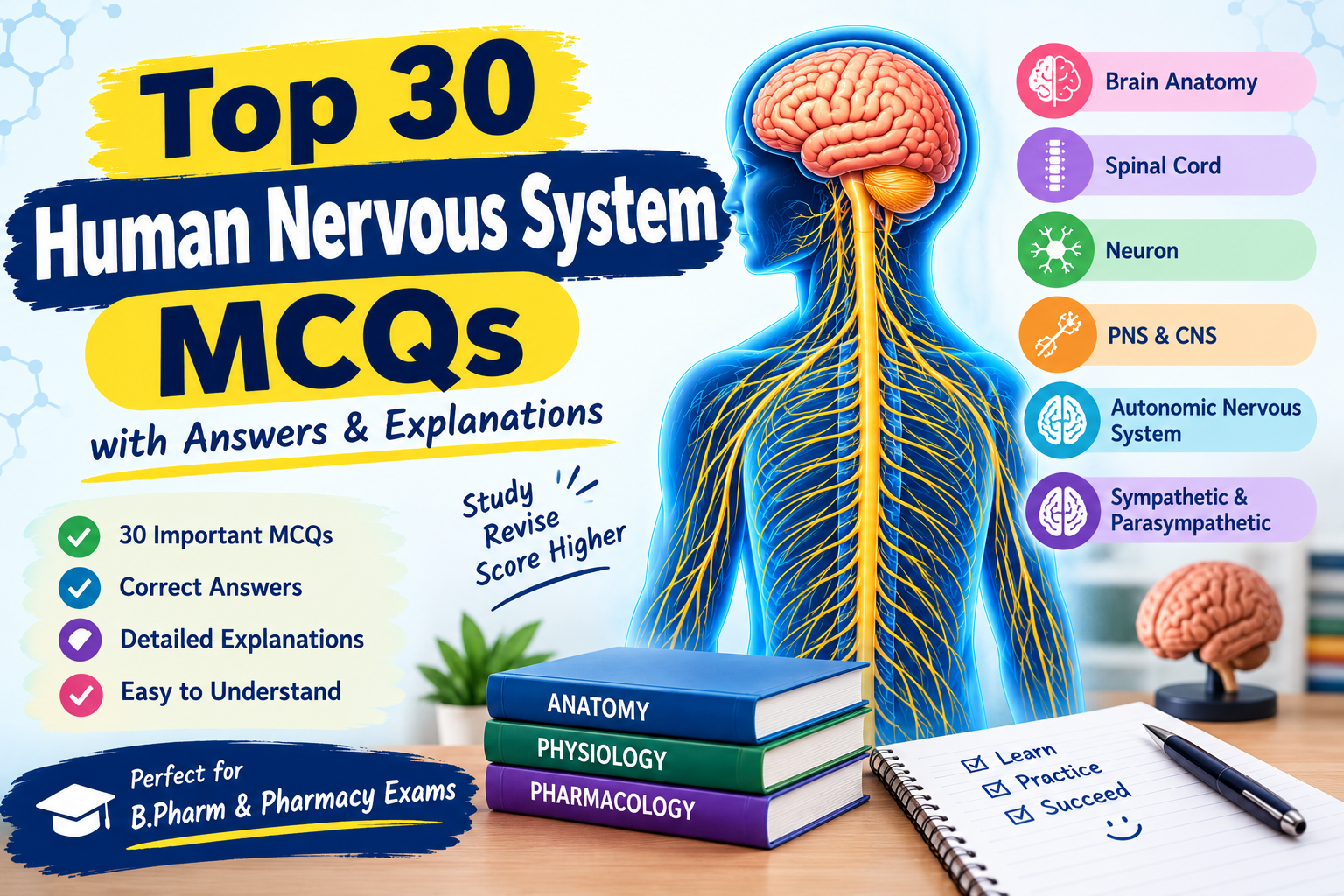
The human nervous system is an important topic in Anatomy & Physiology and provides the foundation for understanding several areas of pharmacology. It includes the brain, spinal cord, peripheral nerves, neurons, and autonomic nervous system.
These 30 Human Nervous System MCQs cover important concepts such as the CNS, PNS, brain, spinal cord, cerebrum, cerebellum, brainstem, neurons, autonomic nervous system, sympathetic and parasympathetic systems, and reflex actions.
1. What is the basic structural and functional unit of the nervous system?
A. Nephron
B. Neuron
C. Osteocyte
D. Alveolus
Correct Answer: B. Neuron
Explanation: The neuron is the basic structural and functional unit of the nervous system. It is specialized to receive and transmit nerve impulses.
2. Which of the following forms the Central Nervous System (CNS)?
A. Brain and spinal cord
B. Brain and cranial nerves
C. Spinal cord and spinal nerves
D. Cranial nerves and spinal nerves
Correct Answer: A. Brain and spinal cord
Explanation: The CNS consists of the brain and spinal cord and acts as the main control and processing center of the body.
3. Which is the largest part of the human brain?
A. Cerebellum
B. Medulla oblongata
C. Cerebrum
D. Pons
Correct Answer: C. Cerebrum
Explanation: The cerebrum is the largest part of the brain and is responsible for higher mental functions, voluntary movements, memory, thinking, and conscious sensation.
4. Which part of the brain is mainly responsible for balance and coordination?
A. Cerebrum
B. Cerebellum
C. Medulla
D. Hypothalamus
Correct Answer: B. Cerebellum
Explanation: The cerebellum plays an important role in maintaining balance, posture, and coordination of voluntary movements.
5. Which lobe of the cerebrum is mainly associated with vision?
A. Frontal lobe
B. Temporal lobe
C. Parietal lobe
D. Occipital lobe
Correct Answer: D. Occipital lobe
Explanation: The occipital lobe contains the primary visual cortex and is mainly involved in processing visual information.
6. Which lobe is mainly associated with hearing?
A. Frontal lobe
B. Temporal lobe
C. Parietal lobe
D. Occipital lobe
Correct Answer: B. Temporal lobe
Explanation: The temporal lobe contains important auditory areas involved in processing sound and also contributes to memory and language comprehension.
7. Which lobe is primarily associated with voluntary motor control, planning, and reasoning?
A. Frontal lobe
B. Occipital lobe
C. Temporal lobe
D. Parietal lobe
Correct Answer: A. Frontal lobe
Explanation: The frontal lobe is involved in voluntary motor control, planning, reasoning, decision-making, personality, and speech production.
8. Which lobe mainly processes sensations such as touch, pressure, pain, and temperature?
A. Frontal lobe
B. Temporal lobe
C. Parietal lobe
D. Occipital lobe
Correct Answer: C. Parietal lobe
Explanation: The parietal lobe contains the primary somatosensory cortex, which processes several types of sensory information from the body.
9. Which structure connects the two cerebral hemispheres?
A. Medulla oblongata
B. Corpus callosum
C. Cerebellum
D. Pons
Correct Answer: B. Corpus callosum
Explanation: The corpus callosum is a large bundle of nerve fibers that allows communication between the right and left cerebral hemispheres.
10. Which of the following is NOT a major division of the brainstem?
A. Midbrain
B. Pons
C. Medulla oblongata
D. Cerebellum
Correct Answer: D. Cerebellum
Explanation: The brainstem consists mainly of the midbrain, pons, and medulla oblongata. The cerebellum is a separate major region of the brain.
11. Which part of the brainstem is especially important in controlling respiration and cardiovascular functions?
A. Cerebrum
B. Cerebellum
C. Medulla oblongata
D. Occipital lobe
Correct Answer: C. Medulla oblongata
Explanation: The medulla contains important autonomic centers involved in functions such as respiration, heart rate, and blood pressure regulation.
12. Which of the following is the innermost meningeal layer?
A. Dura mater
B. Arachnoid mater
C. Pia mater
D. Periosteum
Correct Answer: C. Pia mater
Explanation: The meninges consist of dura mater, arachnoid mater, and pia mater. Pia mater is the innermost layer and closely covers the brain and spinal cord.
13. Which meningeal layer is the outermost?
A. Pia mater
B. Arachnoid mater
C. Dura mater
D. Endoneurium
Correct Answer: C. Dura mater
Explanation: Dura mater is the tough outermost layer of the meninges surrounding the CNS.
14. What is the main function of the spinal cord?
A. Producing hormones
B. Connecting the brain with the body and coordinating reflexes
C. Digesting food
D. Producing red blood cells
Correct Answer: B. Connecting the brain with the body and coordinating reflexes
Explanation: The spinal cord carries sensory and motor information between the brain and body and serves as a center for many reflex actions.
15. Which nervous system consists mainly of nerves outside the brain and spinal cord?
A. Central nervous system
B. Peripheral nervous system
C. Limbic system
D. Ventricular system
Correct Answer: B. Peripheral nervous system
Explanation: The PNS includes nerves and structures outside the brain and spinal cord and connects the CNS with the rest of the body.
16. Which division of the nervous system mainly controls skeletal muscles?
A. Autonomic nervous system
B. Somatic nervous system
C. Enteric nervous system
D. Endocrine system
Correct Answer: B. Somatic nervous system
Explanation: The somatic nervous system is primarily responsible for voluntary control of skeletal muscles and carries sensory information from the body to the CNS.
17. Which system mainly controls involuntary functions of internal organs?
A. Somatic nervous system
B. Autonomic nervous system
C. Skeletal system
D. Sensory system
Correct Answer: B. Autonomic nervous system
Explanation: The autonomic nervous system regulates many involuntary functions involving organs, glands, smooth muscle, and cardiac muscle.
18. Which division is commonly associated with the “fight or flight” response?
A. Parasympathetic nervous system
B. Sympathetic nervous system
C. Somatic nervous system
D. Enteric nervous system
Correct Answer: B. Sympathetic nervous system
Explanation: The sympathetic nervous system prepares the body for activity or stress, commonly described as the fight-or-flight response.
19. Which division is commonly associated with “rest and digest”?
A. Sympathetic nervous system
B. Parasympathetic nervous system
C. Somatic nervous system
D. Central nervous system
Correct Answer: B. Parasympathetic nervous system
Explanation: The parasympathetic nervous system supports routine functions such as digestion, salivation, and energy conservation.
20. Which part of a neuron usually receives signals from other neurons?
A. Axon
B. Dendrites
C. Myelin sheath
D. Synaptic cleft
Correct Answer: B. Dendrites
Explanation: Dendrites are specialized projections that generally receive signals and conduct them toward the cell body.
21. Which part of the neuron generally carries impulses away from the cell body?
A. Dendrite
B. Axon
C. Nucleus
D. Cell membrane
Correct Answer: B. Axon
Explanation: The axon carries nerve impulses away from the cell body toward another neuron, muscle, or gland.
22. What is the major function of the myelin sheath?
A. Producing neurotransmitters
B. Increasing the speed of nerve impulse conduction
C. Producing hormones
D. Digesting damaged neurons
Correct Answer: B. Increasing the speed of nerve impulse conduction
Explanation: Myelin provides electrical insulation around many axons and allows nerve impulses to travel more rapidly.
23. What is a synapse?
A. The nucleus of a neuron
B. A junction involved in communication between neurons or other cells
C. The outer layer of the brain
D. A part of the spinal bone
Correct Answer: B. A junction involved in communication between neurons or other cells
Explanation: A synapse is a specialized junction where communication occurs between neurons or between a neuron and another target cell.
24. Which of the following is a neurotransmitter?
A. Insulin
B. Acetylcholine
C. Hemoglobin
D. Bile
Correct Answer: B. Acetylcholine
Explanation: Acetylcholine is an important neurotransmitter involved in communication within the nervous system and at neuromuscular junctions.
25. Which of the following is another important neurotransmitter in the CNS?
A. Dopamine
B. Albumin
C. Keratin
D. Collagen
Correct Answer: A. Dopamine
Explanation: Dopamine is a neurotransmitter involved in several functions, including movement, motivation, reward, and cognition.
26. Which sequence correctly represents a basic reflex arc?
A. Effector → CNS → Receptor → Sensory neuron
B. Receptor → Sensory neuron → CNS → Motor neuron → Effector
C. Motor neuron → Receptor → CNS → Effector
D. CNS → Receptor → Sensory neuron → Effector
Correct Answer: B. Receptor → Sensory neuron → CNS → Motor neuron → Effector
Explanation: A basic reflex arc begins with a receptor detecting a stimulus, followed by sensory transmission to the CNS and then a motor response to the effector.
27. Which response is generally produced by sympathetic activation?
A. Decreased heart rate
B. Increased heart rate
C. Increased digestive activity
D. Increased salivation
Correct Answer: B. Increased heart rate
Explanation: Sympathetic activation generally increases heart rate and prepares the body for increased physical activity or stress.
28. Which response is generally associated with parasympathetic activity?
A. Increased heart rate
B. Pupil dilation
C. Increased digestive activity
D. Reduced salivation
Correct Answer: C. Increased digestive activity
Explanation: Parasympathetic activity promotes digestive functions and supports the body’s resting state.
29. Which part of the brain is primarily responsible for higher mental functions such as thinking and memory?
A. Cerebrum
B. Medulla oblongata
C. Cerebellum
D. Pons
Correct Answer: A. Cerebrum
Explanation: The cerebrum is responsible for higher brain functions including thinking, learning, memory, intelligence, conscious sensation, and voluntary movement.
30. Which of the following is most closely associated with coordination of voluntary movements?
A. Cerebellum
B. Medulla oblongata
C. Spinal meninges
D. Occipital lobe
Correct Answer: A. Cerebellum
Explanation: The cerebellum coordinates voluntary movements and contributes to balance, posture, and smooth muscle activity.
📋Quick Revision
📌 CNS = Brain + Spinal cord
📌 PNS = Nerves and structures outside the CNS
📌 Cerebrum = Higher mental functions
📌 Cerebellum = Balance and coordination
📌 Medulla = Important autonomic functions
📌 Frontal lobe = Motor control, planning, reasoning
📌 Parietal lobe = Somatic sensation
📌 Temporal lobe = Hearing and memory
📌 Occipital lobe = Vision
📌 Dendrites = Receive signals
📌 Axon = Carries impulses away from cell body
📌 Myelin = Increases conduction speed
📌 Sympathetic = Fight or flight
📌 Parasympathetic = Rest and digest
📌 Neuron = Basic structural and functional unit of the nervous system
🎯Conclusion
The human nervous system is an essential topic for B.Pharm and pharmacy competitive examinations. Understanding the CNS, PNS, brain regions, spinal cord, neurons, neurotransmitters, and autonomic nervous system provides a strong foundation for studying Anatomy & Physiology and Pharmacology.
Regular practice of MCQs can help pharmacy students revise important concepts and prepare effectively for pharmacy examinations.
Keep practicing and strengthen your Anatomy & Physiology fundamentals!